

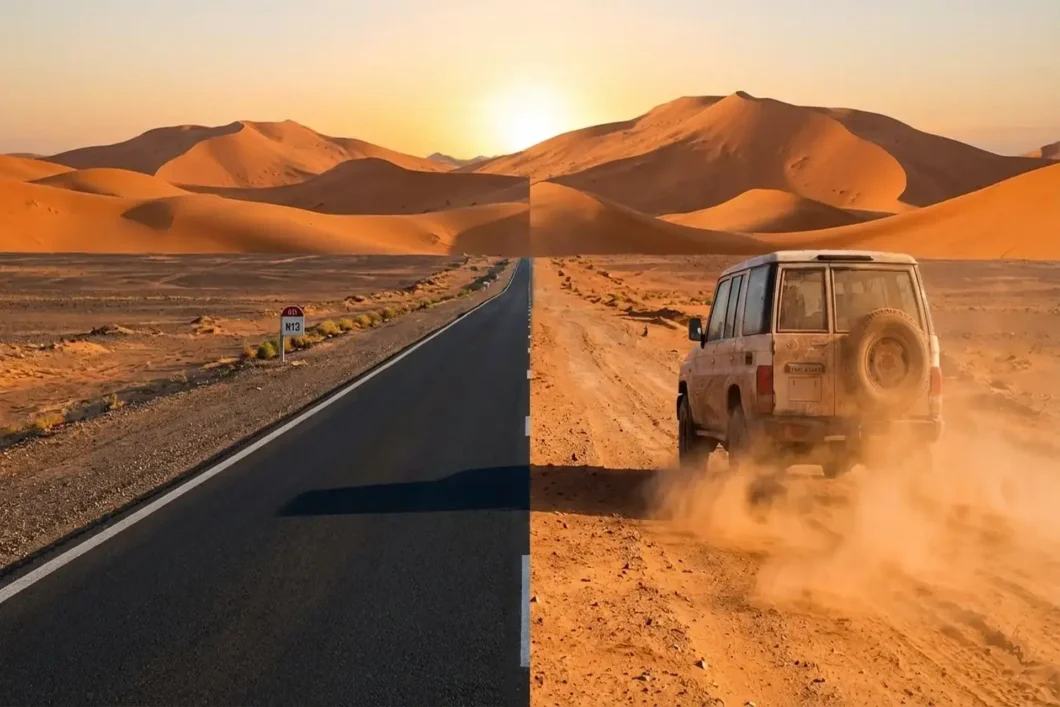
The N13 highway to Merzouga is entirely paved, but the real question isn’t whether you can drive there—it’s what happens when the asphalt ends and the sand begins.
Here are the most common questions we receive about driving to Merzouga: A: Can a standard car reach Merzouga? B: Do I need a 4×4 for the Sahara? C: Where do I park when staying in the desert? D: What are the road conditions like?
In short, the answers key is as follows:
A: Yes, the paved road goes all the way to the village.
B: Only if you plan to drive off-road yourself.
C: Secure parking is available in Merzouga and Hassilabied.
D: Excellent on the N13, challenging on desert tracks.
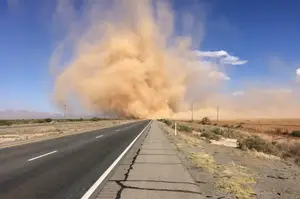
Let’s clear up the biggest misconception about driving to Merzouga: You don’t need a 4×4 to reach the village itself. The N13 national highway is entirely paved from Ouarzazate through Tinghir, Erfoud, and all the way to Merzouga. A standard sedan, compact car, or even a small hatchback can make this journey without any issues.
The route from Ouarzazate to Merzouga covers roughly 370 kilometers and takes about 5-6 hours of driving time. The road quality is surprisingly good for most of this journey. You’ll pass through dramatic landscapes—the Dadès Valley, Todra Gorges, and the date palm oases of the Ziz Valley—all on well-maintained asphalt.
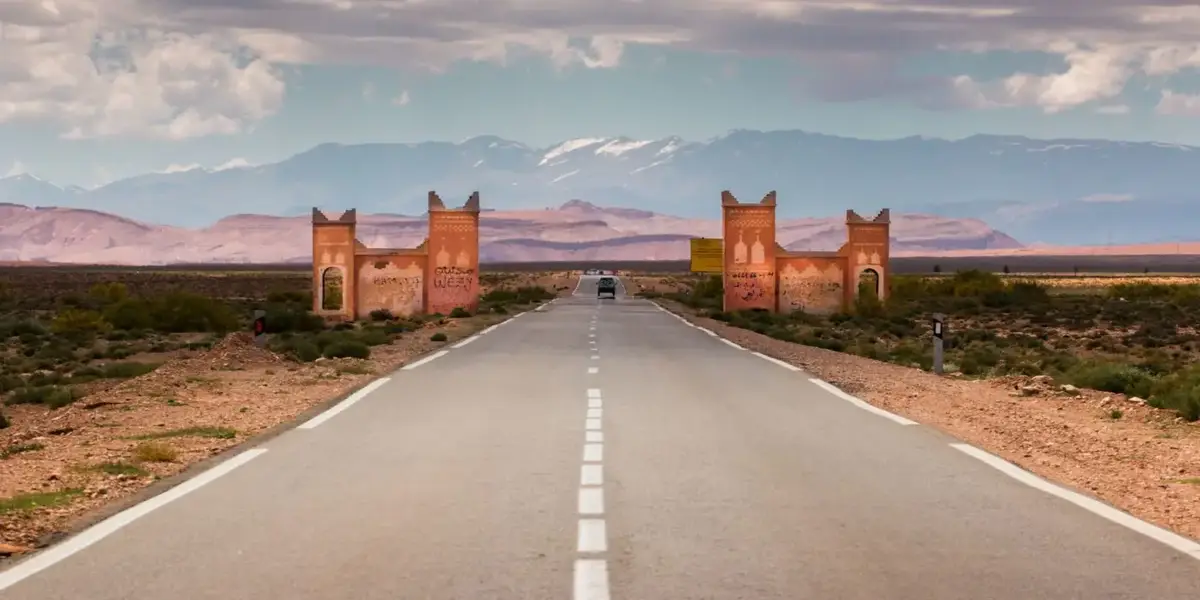
The final stretch from Erfoud to Merzouga (about 50 km) continues on paved road, winding through flat desert terrain dotted with the occasional village. You’ll see the massive orange dunes of Erg Chebbi rising in the distance long before you arrive. The road leads directly into the village of Merzouga, where hotels, restaurants, and tour operators line the main street.
However, many travelers confuse “reaching Merzouga” with “reaching the desert camps.” This is where the confusion—and the critical vehicle decision—comes into play.
The “Last Mile” Problem: From Pavement to Sand
The real challenge isn’t getting to Merzouga—it’s what happens next. Most travelers don’t want to sleep in the village itself. They want the full Sahara experience: sleeping in a traditional Berber camp nestled among the towering dunes of Erg Chebbi. And that’s where the asphalt ends and the sand begins.
Desert camps are typically located 5 to 15 kilometers from the village, accessible only via sandy tracks. Some camps sit at the base of the dunes, while others are tucked deeper into the erg, surrounded entirely by sand. No paved roads lead to these camps. This is the “last mile problem” that catches many travelers off guard.
Your standard rental car can get you to Merzouga village, but it absolutely cannot drive on soft sand. Attempting to do so will result in getting hopelessly stuck within minutes. The sand is fine and deep, and without 4×4 capability, proper tires, and sand-driving experience, you’re setting yourself up for an expensive rescue operation.
This is why virtually all desert camps offer transfers from Merzouga village as part of their package. These transfers typically use one of three methods: 4×4 vehicles driven by experienced locals, camel treks (the traditional and most photogenic option), or quad bikes for those seeking a bit more adventure. The transfer is usually included in your camp booking or available for a small additional fee.
Transfer Options from Village to Camp
Most camps handle the logistics for you. When you book a desert camp, confirm the following:
- Does the price include transfer from Merzouga village to the camp?
- What type of transfer is included (4×4, camel, quad)?
- Where exactly should you meet the transfer (many camps have a meeting point in the village)
- What time does the transfer depart (usually late afternoon to arrive before sunset)
- Is return transfer in the morning included?
The camel trek option is popular because it’s part of the experience—watching the sunset from atop a camel as you cross the dunes is a highlight for most visitors. However, it’s slower (45 minutes to 1.5 hours depending on camp location) and not suitable for everyone. If you have mobility issues, prefer speed, or simply aren’t interested in riding a camel, request a 4×4 transfer instead.
4×4 vs. 2WD: The Decision Matrix
The question isn’t really “Do I need a 4×4?” but rather “What do I want to do once I’m in Merzouga?” Your vehicle choice should depend on your plans, experience level, and where you’re staying. Let’s break down when each option makes sense.
When a Standard 2WD Car is Perfectly Fine
Parking Logistics in Merzouga
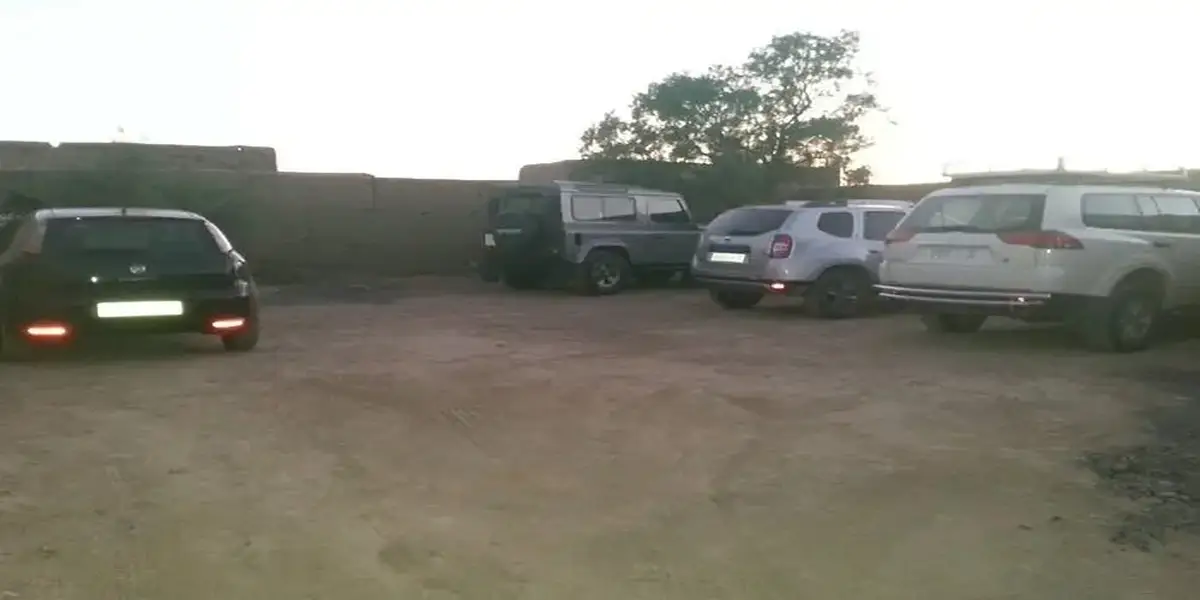
Once you arrive in Merzouga, you’ll need to leave your vehicle somewhere safe while you’re off in the dunes. Most travelers spend 1-2 nights in desert camps, meaning your car will be parked for 24-48 hours. Here’s what you need to know about secure parking options.
Hotel and Camp Parking
If you’re staying at a hotel in Merzouga village before or after your desert camp experience, most hotels offer free parking for guests. Popular options include:
Alternatives to Driving Yourself
Not everyone wants the responsibility of driving to Merzouga. Fortunately, excellent alternatives exist that remove the driving stress entirely while still allowing you to experience the journey.
Organized Tours from Marrakech or Fes
Multi-day tours that include Merzouga are extremely popular and solve all logistics: