

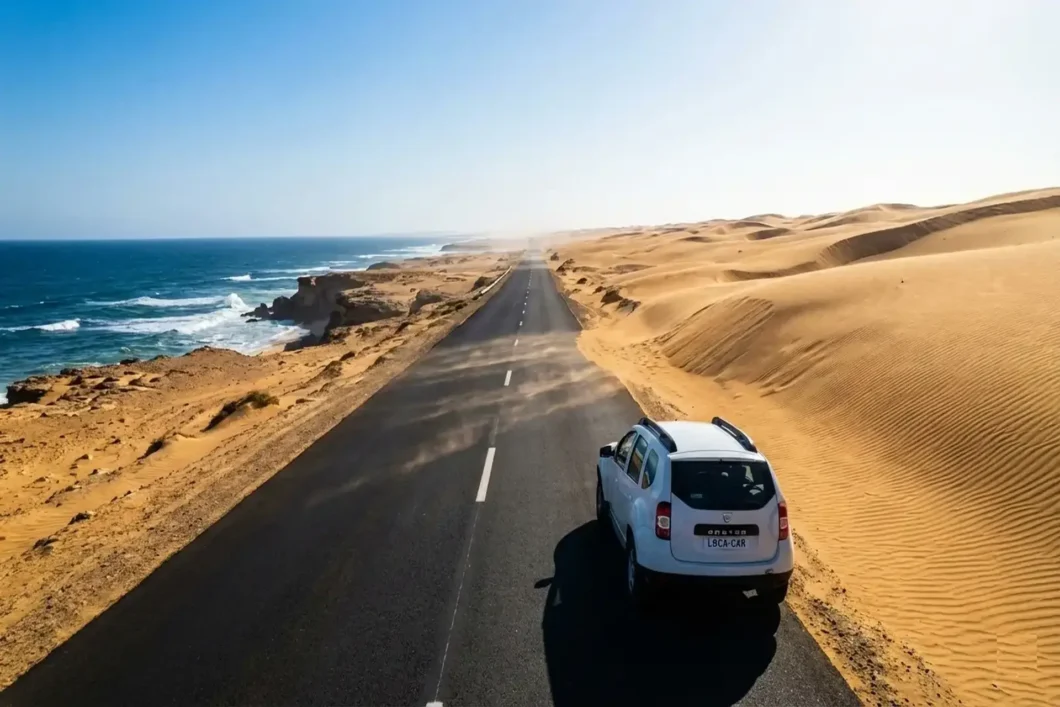
Thinking about renting a car to reach Dakhla? Before you book that rental from Marrakech or Agadir, you need to understand the reality of this journey. I’m talking about 1,420 kilometers of desert highway, fuel autonomy calculations, military checkpoints, and rental company restrictions that most tourists discover too late.
After helping dozens of travelers plan their Dakhla road trips and making the drive myself three times, I’ve learned what works and what doesn’t. This isn’t your typical Morocco drive. The distance alone is one thing, but add in fuel station gaps, checkpoint protocols, and insurance complications — suddenly that car rental Dakhla idea needs serious reconsideration.
Let me be straight with you: most people shouldn’t drive to Dakhla. But if you’re still reading, you’re either stubborn like me or you have good reasons for the road trip. Either way, I’ll give you everything you need to make this journey work, starting with the brutal truth about distances.
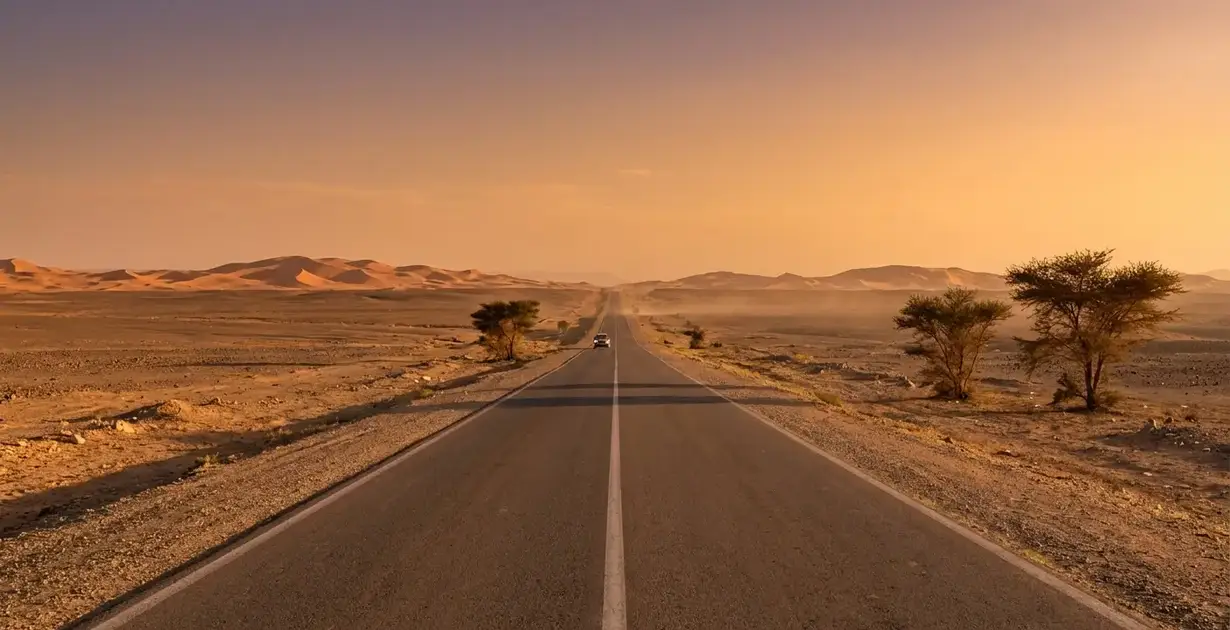
The highway stretches endlessly through Morocco’s deep south — prepare for hours of open desert driving
The Distance Reality (Numbers That Matter)
Let’s start with what nobody tells you in the tourism brochures. Dakhla sits at the edge of Western Sahara, and getting there means crossing nearly the entire length of Morocco.
From Marrakech, you’re looking at 1,420 kilometers — that’s 14 to 16 hours of pure driving time. Not tourist time with photo stops and lunch breaks. Pure, eyes-on-the-road driving. Most GPS apps will tell you 13 hours, but they don’t account for the reality of Moroccan highways or the mandatory fuel stops you’ll need.
Agadir is closer at 1,120 kilometers, shaving off about 300km and 3 hours. Still, you’re committing to 11-13 hours behind the wheel. If you’re flying into Morocco and thinking “I’ll just grab a car rental at the airport and head south,” think again.
The smart starting point? Laayoune. At 540 kilometers from Dakhla, this is where most experienced travelers begin the drive. It’s a manageable 5-6 hour journey, and Laayoune has legitimate car rental agencies that allow Dakhla trips. You can fly from Casablanca to Laayoune, rent locally, and save yourself two days of desert driving.
Here’s what kills most road trip plans: the return journey. Whatever distance you drive to reach Dakhla, you need to drive back. That Casablanca to Dakhla fantasy? You’re looking at 1,650 kilometers each way. That’s 3,300 kilometers round trip — roughly the distance from New York to Los Angeles. For a beach vacation.
Daily driving limits matter more in Morocco than anywhere else I’ve traveled. Between the heat, the monotony of desert highways, and the aggressive driving culture in cities, 500 kilometers per day is the maximum you should plan for safely. That makes Dakhla a minimum three-day journey one way from anywhere north of Agadir.
| Starting Point | Distance to Dakhla | Driving Time | Minimum Days (One Way) |
|---|---|---|---|
| Marrakech | 1,420km | 14-16 hours | 3 days |
| Agadir | 1,120km | 11-13 hours | 3 days |
| Laayoune | 540km | 5-6 hours | 1 day |
| Casablanca | 1,650km | 16-18 hours | 4 days |
The calculation is simple but harsh: if you have a week in Morocco, you’ll spend six days driving for one day in Dakhla. That’s when most people realize flying makes more sense. But if your plan involves exploring the route itself — hitting Essaouira, the Anti-Atlas, and coastal towns along the way — then the drive becomes the destination.
Fuel Autonomy – The Critical Calculation
This is where amateur road trips to Dakhla fail. Fuel availability in Morocco’s deep south isn’t like driving through Europe or North America. There are sections of this route where you won’t see a gas station for over 100 kilometers, and running out of fuel in 40°C desert heat is not a learning experience you want.
The longest fuel gap sits between Tan Tan and Tarfaya — 103 kilometers of empty highway. Then you hit Tarfaya to Laayoune, another 98 kilometers. After Laayoune, the next reliable fuel stop is Boujdour at 165 kilometers. These gaps don’t sound catastrophic until you factor in your vehicle’s actual fuel consumption versus what the rental company claims.
Fuel stations become scarce south of Tan Tan — never skip a refueling opportunity
Most economy cars come with 45-liter fuel tanks. The rental agent will tell you this gives you 650-700 kilometers of range. They’re lying — or rather, they’re quoting the manufacturer’s ideal highway consumption figures. Real-world Dakhla road conditions mean you should add 15-20% to fuel consumption estimates. Heat increases consumption, so does running air conditioning non-stop (which you will), so does the occasional burst of speed to overtake slow trucks.
A 45-liter Dacia Sandero, Morocco’s most common rental car, gives you about 600-650 kilometers of real range. That barely covers Laayoune to Dakhla with one fuel stop in Boujdour. Miss that Boujdour station or arrive when it’s closed, and you’re gambling with your safety. I’ve seen tourists sitting roadside in Boujdour waiting for the station to reopen, having passed the Laayoune fuel stop with half a tank because “we’ll fill up later.”
Checkpoint Logistics (2026 Protocol)
If you’ve driven elsewhere in Morocco, checkpoints might seem like minor inconveniences. The Dakhla route is different. You’re entering Western Sahara, a disputed territory with a significant military presence. Checkpoints here are serious, frequent, and non-negotiable.
Expect four major checkpoints: Tan Tan, Tarfaya, Laayoune, and Boujdour. There are also random checkpoints that can pop up anywhere, particularly between Boujdour and Dakhla. Some days you’ll sail through with a quick ID check. Other days, you’ll be questioned for 15 minutes about your travel plans.
Required Documents
Keep these in your glove box at all times, not buried in your luggage:
Rental Company Restrictions (The Fine Print)
Here’s where most Dakhla road trip plans hit a wall. Not every car rental company in Morocco allows their vehicles to travel to Western Sahara. Many local agencies explicitly prohibit it, and if you ignore that restriction, your insurance becomes void the moment you cross into the region.

Always verify Western Sahara authorization in writing before signing any rental contract
Companies That Allow Dakhla
The major international agencies generally permit Western Sahara travel, but you must verify current 2026 policies before booking:
- Hertz: Allows Dakhla with full insurance package
- Avis: Permits Western Sahara, requires documentation
- Europcar: Generally allows, check specific vehicle restrictions
- Sixt: Permits with advance notification and insurance upgrade
Car Type Requirements
The highway to Dakhla is paved the entire way, so theoretically you could make the journey in a small economy car. Theoretically. In reality, vehicle choice matters more than most people realize.
Engine Power
Minimum 90 horsepower. The route includes sections through the Anti-Atlas mountains where you’ll be overtaking slow-moving trucks on inclines. A underpowered 60hp economy car will struggle, especially when fully loaded with passengers and luggage in 40°C heat.
The long straightaways in the desert also create a psychological challenge — you’ll want power reserves for safe overtaking. Moroccan truck drivers don’t always stay in their lane, and you need acceleration to get past them quickly.
Ground Clearance
Route Breakdown – Stage by Stage
Breaking the journey into manageable stages is essential for safety and sanity. Here’s the route that makes sense, assuming you’re starting from Agadir (the most common departure point for Dakhla drives).
Stage 1: Agadir → Tan Tan (385km, 4-5 hours)
This is your easiest day. The road is good, traffic is manageable, and you’re still in the tourism zone. Agadir to Tan Tan takes you through Tiznit and along the Atlantic coast before cutting inland.
Key stops and considerations:
- Fuel in Agadir: Fill up completely at a major station before leaving
- Tiznit: Good midpoint break, about 90km from Agadir
- Tire pressure check: Stop at a garage in Tiznit or Sidi Ifni to verify tire pressure. Heat expansion ahead means you want proper inflation
- Tan Tan arrival: Arrive with time to find accommodation. This is your last comfortable city before deep south
Tan Tan offers several hotels ranging from budget to mid-range. Book ahead in summer months. Use this stop to restock water and snacks — options become limited beyond this point.
Stage 2: Tan Tan → Laayoune (280km, 3 hours)
You’re now entering Western Sahara. The landscape becomes emptier, the wind picks up, and you’ll hit your first serious checkpoints.
- Checkpoint: Tan Tan exit — have documents ready
- Tarfaya fuel stop (km 103): MANDATORY. Don’t skip this even if you think you can make Laayoune
- Tarfaya town: Historic Spanish colonial town, worth a 30-minute walk if you have time
- Checkpoint: Laayoune entrance
I strongly recommend overnighting in Laayoune rather than pushing through to Dakhla in one day. Fatigue is real, and the final 540km stretch is mentally draining. Laayoune has decent hotels and good restaurants. It’s also your last chance to get any forgotten supplies or make vehicle repairs.
Stage 3: Laayoune → Dakhla (540km, 5-6 hours)
The longest, emptiest stretch. This is where the journey either becomes meditative or mind-numbing, depending on your personality.
- Fuel in Laayoune: Fill up at a major station. This is your last reliable fuel until Boujdour
- Boujdour stop (165km): Fuel available, worth a break to stretch
- Checkpoint: Boujdour exit
- Final 375km: Empty desert highway, minimal services
The scenery is stark and beautiful in a desolate way. Endless flat desert, occasional military installations, and the Atlantic Ocean appearing and disappearing on your left. Bring podcasts or music — phone signal is intermittent at best.
As you approach Dakhla, you’ll see a massive sand dune called the “White Dune” to your right. That’s your signal you’re close. The city appears suddenly after hours of emptiness.
Alternative Starting Point: Marrakech
If you’re committed to driving from Marrakech, add these stages to the beginning:
- Day 1: Marrakech → Agadir (250km, 3 hours) via the Tizi n’Test pass or the main highway
- Day 2: Agadir → Tan Tan (385km, 4-5 hours)
- Day 3: Tan Tan → Laayoune (280km, 3 hours)
- Day 4: Laayoune → Dakhla (540km, 5-6 hours)
That’s four full driving days one way. Add in your time in Dakhla, then four days back. For anyone with less than 12-14 days total vacation, consider other Morocco road trip routes or fly to Dakhla and rent locally.
[/showhide]Alternative Transport Methods Comparison
Before you commit to driving 1,400 kilometers, let’s look at every way to reach Dakhla and what each method actually costs in time and money.
| Method | Duration | Cost (one-way) | Flexibility | Luggage |
|---|---|---|---|---|
| Rental car (round trip) | 3 days down + 3 up | 400-600€ | High | Unlimited |
| One-way rental | 2 days | 350€ + 400€ drop fee | Medium | Unlimited |
| CTM bus | 24h overnight | 60€ | Zero | 2 bags |
| Domestic flight | 2h (Casablanca) | 80-150€ | Medium | 23kg |
| Shared grand taxi | 12-14h | 50€ | Low | 1 bag |
The CTM Bus Option
When Flying Makes More Sense
Let me save you from the mistake I made on my first Dakhla trip: I drove from Marrakech because I thought it would be “an adventure.” It was an adventure in sleep deprivation and highway monotony. By the time I reached Dakhla, I’d spent so much time driving that I had barely any time to actually enjoy the destination.
The Time Value Calculation
Driving from Agadir to Dakhla and back takes a minimum of 6 full days. That’s 6 days where your main activity is watching asphalt. Flying takes 4 hours total when you factor in airport time. That’s 5.75 days you get back to actually spend in Dakhla or elsewhere in Morocco.
If your vacation is 10-14 days total, spending 60% of it driving makes no sense unless the journey itself is your goal. For anyone primarily interested in Dakhla’s kitesurfing, beaches, or flamingo lagoons, flying is the obvious choice.
Local Car Rental in Dakhla
Here’s the strategy most experienced travelers use: fly to Dakhla, rent a car locally for 3-5 days, explore the region, return the car, fly back. Total cost is often cheaper than driving from the north when you factor in fuel, accommodation, meals, and wear on your nerves.
Dakhla has several legitimate rental agencies near the airport. Vehicles are typically newer than what you’d rent in Marrakech (lower mileage, less tourist wear), and daily rates are competitive at 30-50€ per day for compact SUVs.
Kitesurfing Equipment Logistics
If you’re traveling to Dakhla specifically for kitesurfing, gear transport becomes a factor. Royal Air Maroc allows sports equipment as checked baggage (with fees), which is simpler than strapping kiteboards to a rental car roof rack and driving 1,400km.
Most Dakhla kitesurf camps also rent equipment, so unless you’re particular about your own gear, you can fly with just clothing and personal items.
Practical Pre-Departure Checklist
If you’ve made it this far and you’re still committed to driving to Dakhla, respect. Here’s your essential checklist to avoid the most common mistakes.
Documentation Verification
- ✓ Rental contract explicitly states Western Sahara is permitted
- ✓ Insurance certificate lists coverage zones including Western Sahara
- ✓ Both documents are in your name and match your passport
- ✓ You have physical copies, not just phone screenshots
- ✓ Hotel booking confirmations for each overnight stop
Vehicle Inspection
- ✓ Spare tire is present and properly inflated
- ✓ Jack and lug wrench are in the vehicle and functional
- ✓ All lights work (headlights, brake lights, turn signals)
- ✓ Windshield wipers and washer fluid full
- ✓ AC works and blows cold air
- ✓ Fuel tank is full when you leave the rental lot
- ✓ Oil level checked (ask rental agent to verify)
- ✓ Tire tread depth adequate for 2,000+ km
Navigation and Communication
- ✓ Offline maps downloaded (Maps.me or Google Maps offline)
- ✓ GPS device or phone mount installed
- ✓ All fuel station locations saved in GPS
- ✓ Checkpoint locations marked
- ✓ Emergency numbers saved: rental agency, insurance, embassy
- ✓ Moroccan SIM card with data (signal is intermittent but worth having)
Emergency Supplies
- ✓ Minimum 5 liters of drinking water per person
- ✓ Non-perishable snacks (nuts, dried fruit, energy bars)
- ✓ Basic first aid kit
- ✓ Sunscreen and hat
- ✓ Flashlight or headlamp
- ✓ Phone power bank fully charged
- ✓ Cash in Moroccan dirhams (some fuel stations don’t take cards)
Weather and Road Conditions
- ✓ Check 7-day weather forecast for Dakhla region
- ✓ Verify no sandstorm warnings (common in spring)
- ✓ Confirm no road closures (rare but possible during extreme weather)
- ✓ Check wind forecasts if traveling in winter (strong Atlantic winds can affect driving)
Sandstorms are the main weather concern. They can reduce visibility to near-zero and force highway closures. If you encounter a sandstorm while driving, pull over completely off the road, turn on hazard lights, and wait it out. Don’t try to push through.
Personal Preparation
- ✓ Tell someone your planned route and check-in schedule
- ✓ Bring entertainment (audiobooks, podcasts, music playlists)
- ✓ Have a printed copy of this guide (phone batteries die)
- ✓ Break in any new sunglasses or hats before the trip
- ✓ Get adequate sleep before long driving days
The Return Journey Factor
Everyone focuses on reaching Dakhla. Nobody thinks about the fact that you need to drive back. This is where fatigue and impatience cause most problems.
Fatigue Management
After spending time in Dakhla — whether it’s 2 days or a week — the idea of another 1,100+ kilometer drive back feels overwhelming. Resist the temptation to rush it.
The return journey requires the same careful staging as the trip down. Overnight in Laayoune is essential. If you try to push from Dakhla to Tan Tan or Agadir in one shot, you’re risking driver fatigue, which is responsible for more accidents than any other factor on this route.
Signs you’re too tired to continue driving:
- Difficulty keeping your eyes open
- Drifting out of your lane
- Missing exits or turns you planned
- Can’t remember the last few kilometers
Final Verdict: Should You Drive to Dakhla?
After everything I’ve laid out — the distances, the fuel calculations, the checkpoints, the costs — here’s my honest recommendation based on why you’re going to Dakhla.
Drive if: You have 2+ weeks and want the journey itself to be part of the experience. You enjoy long-distance driving. You’re planning stops along the Atlantic coast and Western Sahara is one piece of a larger Morocco road trip. You’re traveling with 3-4 people who can share driving duties and split costs. You need a vehicle in Dakhla for accessing remote kitesurfing spots or exploring beyond the city.
Fly if: You have 10 days or less. Your primary interest is Dakhla itself (kitesurfing, beaches, wildlife) rather than the journey. You’re traveling solo or as a couple. You value your vacation time over the “adventure” of desert driving. You want to minimize hassle and maximize time at your destination.
The math is brutal: from anywhere north of Agadir, you’ll spend more time driving than enjoying Dakhla unless you have at least 14 days total. For most travelers, that math doesn’t work.
But if you’re the type who finds beauty in empty desert highways, who actually wants to see Tan Tan and Laayoune, who considers checkpoint interactions and fuel strategy part of the adventure — then yes, absolutely drive. Just do it properly with the right vehicle, proper planning, and realistic time expectations.
Morocco’s deep south isn’t for casual road-trippers. It requires preparation, patience, and respect for the distances involved. Done right, though, reaching Dakhla by car gives you a perspective on Morocco that few tourists ever experience.
You’ll see the landscape change from green valleys to red earth to pure desert. You’ll understand why Laayoune exists as an oasis city. You’ll watch the Atlantic Ocean appear and disappear as the highway winds along the coast. You’ll earn your arrival in Dakhla in a way that flying never provides.
Just make sure you’ve thought through every element I’ve covered here. The worst Dakhla road trips happen when people underestimate the distance, overestimate their vehicle, or ignore the fuel realities. The best ones happen when you’ve planned properly and given yourself enough time to actually enjoy both the journey and the destination.
Choose wisely. And if you choose to drive, choose early morning departures, full insurance, and conservative fuel estimates. Your future self will thank you.