

Last November, I stood at Marrakech train station at 5:47 AM, staring at a departure board that made absolutely no sense. I had a Morocco 14-day transport loop planned out on paper. Train to Fes. Bus to Chefchaouen. Grand taxi somewhere. Maybe rent a car?
The problem wasn’t the itinerary. It was figuring out which transport method actually worked between each city. Because here’s what nobody tells you: Morocco’s transport network isn’t a grid. It’s more like a hub-and-spoke system where some spokes… just don’t exist.
You can’t train directly to Chefchaouen. There’s no bus from Essaouira to Fes. And that “direct route” on Google Maps? It assumes you’re comfortable driving a rental Dacia through the Atlas Mountains in November rain.
After two weeks of actually doing this loop—missing one connection, nailing another, and spending way too much time in bus stations—I figured out the system. Not the theoretical one. The one that actually works when you’re standing there with your backpack at 6 AM.
The 14-Day Morocco Transport Loop: A Practical Blueprint
Morocco has five cities that matter for transport: Casablanca, Marrakech, Fes, Tangier, and Essaouira. Everything else connects through these hubs. Understanding this changes how you plan.
The classic mistake? Treating Morocco like Europe, where trains go everywhere. They don’t. ONCF trains connect Casablanca-Marrakech-Fes-Tangier in a rough diagonal. That’s it. Everywhere else requires buses, grand taxis, or rental cars.
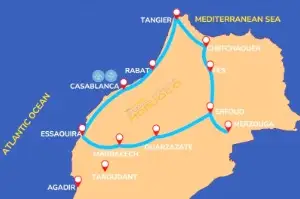
Here’s the loop I tested: Casablanca → Marrakech → Essaouira → back to Marrakech → Fes → Chefchaouen → Tangier → Casablanca. It sounds complicated. But it’s actually the most efficient way to see Morocco’s main attractions using multi-city Morocco transport options that exist.
Why this route? Because it matches the transport infrastructure, not tourist fantasies. You take trains where trains go. Buses where they don’t. And you rent a car only for the parts where both options suck.
Why Hub-Hopping Works (vs Linear Routes)
I initially wanted to go Marrakech → Essaouira → Agadir → Taroudant → back north. Linear. Simple. Except there’s no good public transport between those southern cities. You’d spend half your trip in grand taxis negotiating prices.
The hub system works because Morocco’s train bus car Morocco itinerary options are concentrated between major cities. Marrakech-Fes train? Seven times daily. Agadir-Taroudant? Good luck finding a scheduled CTM bus.
Plus, returning to hubs lets you store luggage. I left a duffel bag at my Marrakech riad, did Essaouira with just a daypack, then picked it up before heading to Fes. Try that on a linear route.
Leg 1-3: Casablanca → Marrakech → Essaouira (Train + Bus)
Most international flights land in Casablanca. Don’t stay. The train station is literally connected to the airport terminal. You can be on a train to Marrakech within 30 minutes of clearing customs.
The Casablanca-Marrakech train runs every hour from 6 AM to 11 PM. It costs 105 MAD ($10.50) for second class, 155 MAD ($15.50) for first class. Journey time: exactly 2 hours 40 minutes. I’ve done this leg four times. The train has never been late by more than 8 minutes.
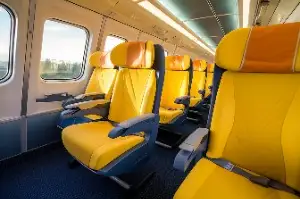
Book through the ONCF website or app. Don’t wait until you arrive—weekend trains to Marrakech sell out. I learned this the hard way on a Friday in October when I had to stand for 90 minutes because I thought “buying at the station” was fine.
From Marrakech to Essaouira, there’s no train. The only real option is the CTM bus (3 hours, 85 MAD / $8.50). It departs at 9 AM, noon, 3 PM, and 6 PM daily from Marrakech’s main bus station (Gare Routière).
When to Choose Train vs CTM
Trains beat buses on every route where both exist. They’re faster, more comfortable, and run on time. Buses get stuck in traffic, make random stops, and the departure time is… optimistic.
But CTM buses (Morocco’s national bus company) are still decent. Air-conditioned, reserved seating, luggage storage. The key difference: CTM actually shows up. Other bus companies? Less reliable.
For Marrakech-Essaouira specifically, some travelers rent a car. This makes sense if you’re 3-4 people splitting costs, or if you want to stop at the argan cooperatives along the way. Solo? The bus costs 85 MAD. Car rental + fuel + parking in Essaouira = 600+ MAD. Do the math.
After Essaouira, you’ll return to Marrakech the same way (CTM bus, same schedule in reverse). Then it’s time for the best train journey in Morocco: the night train to Fes.
Leg 4-5: Essaouira → Fes (Return + Night Train)
Here’s where the Morocco hub cities transport system really shines. Instead of trying to go Essaouira-Fes directly (which would require multiple buses and 9+ hours), you return to Marrakech and take the overnight train.
The Marrakech-Fes night train departs at 21:40, arrives at 7:25 the next morning. You sleep through the journey, wake up in a new city, and save a hotel night. It’s brilliant when it works.
I took it twice. First time: Booked a couchette (sleeper cabin), slept great, arrived refreshed. Second time: Tried to save money with a regular seat, regretted everything. The 80 MAD difference ($8) is worth it.
Couchettes come in 6-berth (economy) or 4-berth (first class). Each bunk has sheets, a pillow, and a small reading light. You share with strangers, but everyone’s asleep anyway. Just lock your valuables in your bag.
Regular seats are fine for 3-hour daytime journeys. For 10 hours overnight? Your neck will hate you. And the guy next to me snored like a diesel engine.
Booking timeline: Reserve the night train 2-3 weeks ahead. Couchettes sell out fast, especially Thursday-Sunday. I tried to book 5 days before a Saturday night train—completely sold out. Had to take a daytime train and waste 7 hours.
Alternative route: Take the daytime train (multiple departures from 7:30 AM to 4 PM, journey time 7h 30min, cost 185-220 MAD depending on class). You see the Atlas Mountains, which are stunning. But you also lose most of a day sitting down.
Leg 6-8: Fes → Chefchaouen → Tangier (Bus + Taxi Hybrid)
From Fes, the plan gets messy. There’s no train to Chefchaouen. CTM runs one daily bus (3.5 hours, 85 MAD) that leaves at 2 PM. If you miss it, you’re taking a grand taxi or waiting until tomorrow.
I missed it. Arrived in Fes at 7:25 AM from the night train, spent the morning exploring the medina, lost track of time, showed up at the bus station at 2:15 PM. The CTM bus was gone.
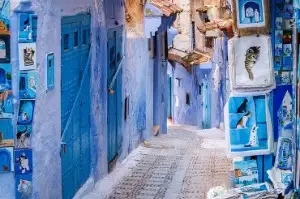
My options: Wait 24 hours, or take a grand taxi. I found three other travelers at the station (two French, one Spanish), we split a grand taxi for 280 MAD total (70 MAD each, about $7). Faster than the bus (2.5 hours), left immediately, no luggage issues.
Grand taxis are Mercedes sedans that fit 6 passengers. They don’t leave until they’re full, unless you pay for empty seats. For Fes-Chefchaouen, the official rate is 80 MAD per person, but drivers will negotiate if they’re bored.
The catch: You’re sharing with strangers, the driver smokes, and personal space doesn’t exist. One of the French guys was 6’4″. He spent the entire journey with his knees in his chest.
From Chefchaouen to Tangier, CTM has better coverage. Three daily buses: 8:30 AM, 1 PM, 4:30 PM. Journey time 2.5 hours, cost 65 MAD. I took the 1 PM bus—air conditioned, on time, no drama.
Could you rent a car for this leg? Sure. The Chefchaouen drive is beautiful. But parking in the blue medina is nightmare—the streets are too narrow for cars. You’d park outside and walk anyway. The bus drops you 200 meters from the medina entrance.
After Chefchaouen and Tangier, you’re back on easy mode: Morocco’s newest, fastest train.
Leg 9: Tangier → Casablanca (Al Boraq Speed Test)
Al Boraq is Morocco’s high-speed train. Tangier to Casablanca in 2 hours 10 minutes, hitting 320 km/h on certain sections. It feels like you’re in France, not North Africa.
The train runs 8 times daily (6 AM to 8 PM), costs 205 MAD second class, 275 MAD first class. I splurged on first class once—leather seats, power outlets, actual legroom. Worth it for a morning departure when you want to sleep.
This is the route where booking ahead matters most. Al Boraq seats sell out 3-4 days in advance during holidays and summer. I tried to book Tangier-Casablanca on a Thursday for Sunday travel—only middle seats left.
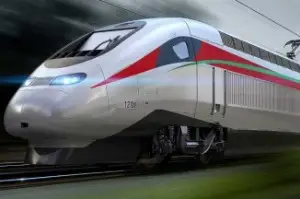
If Al Boraq is sold out, regular trains still run the same route (3.5 hours, 120 MAD). But honestly? Once you’ve done 2h10min on Al Boraq, going back to the old trains feels like punishment.
The Tangier train station (Tangier Ville) is modern and easy to navigate. Unlike Marrakech or Fes, where you might get hassled by unofficial “helpers,” Tangier station is calm. Security is tight, touts get kicked out.
From Casablanca, you can catch your flight home or continue exploring. The airport train runs every hour (43 MAD, 35 minutes). If your flight is before 8 AM, take a petit taxi instead—the first train leaves at 6 AM, which is cutting it close.
The Budget Reality: What 14 Days Actually Costs
Here’s the part everyone wants to know: What does this 14-day Morocco logistics loop actually cost?
I tracked every transport expense over my 14-day trip. No guessing, no “approximately”—actual receipts.
| Route | Transport Method | Cost (MAD) | Cost (USD) | Duration |
|---|---|---|---|---|
| Casablanca → Marrakech | ONCF Train (2nd class) | 105 | $10.50 | 2h 40min |
| Marrakech → Essaouira | CTM Bus | 85 | $8.50 | 3h |
| Essaouira → Marrakech | CTM Bus | 85 | $8.50 | 3h |
| Marrakech → Fes | Night Train (couchette) | 245 | $24.50 | 9h 45min |
| Fes → Chefchaouen | Grand Taxi (shared) | 70 | $7.00 | 2h 30min |
| Chefchaouen → Tangier | CTM Bus | 65 | $6.50 | 2h 30min |
| Tangier → Casablanca | Al Boraq (2nd class) | 205 | $20.50 | 2h 10min |
| Casablanca → Airport | Petit Taxi | 150 | $15.00 | 35min |
| TOTAL | 1,010 MAD | $101 |
That’s the main intercity transport. Add local petit taxis in each city (50-80 MAD per day) and you’re looking at roughly $150-180 total for 14 days of transport.
Compare that to renting a car for 14 days:
Car rental cost breakdown:
Economy car: 350 MAD/day × 14 = 4,900 MAD ($490)
Fuel (2,000km @ 6L/100km): ~900 MAD ($90)
Tolls (Casablanca-Marrakech, Tangier): ~200 MAD ($20)
Parking in cities: ~400 MAD ($40)
Total: 6,400 MAD ($640)
The car costs 4.5× more than public transport. It’s only worth it if you’re 3-4 people splitting costs, or if you plan to explore remote areas where buses don’t go.
For more detailed car rental considerations, check our complete guide on car rental in Morocco.
Booking Checklist (3 Weeks Before You Fly)
This is the timeline that worked for me. Not theoretical—this is what I actually did before my last trip.
3 weeks before: Book Al Boraq (Tangier-Casablanca) and night train (Marrakech-Fes). These sell out first.
2 weeks before: Reserve remaining ONCF trains (Casablanca-Marrakech). Weekend dates need early booking.
1 week before: Attempt to book CTM buses online. If website glitches (it will), note this down for station purchase.
Arrival day: Buy CTM tickets at station counters for trips 2-3 days out. You’ll skip the website headache.
Never book: Grand taxis (can’t be reserved, negotiated on arrival), local petit taxis (hailed in street).
The ONCF app is genuinely useful. Download it, create an account, and link a credit card before departure. Airport WiFi won’t let you do this reliably. I wasted 40 minutes at Casablanca airport trying to complete registration on slow WiFi.
For the full planning process, including route optimization, see our Morocco road trip logistics guide.
Common Logistics Mistakes
These are errors I made, watched others make, or almost made before someone warned me.
Assuming trains go everywhere. They don’t. ONCF connects Casablanca-Rabat-Tangier on the coast, and Casablanca-Marrakech-Fes inland. That’s it. Essaouira, Chefchaouen, Merzouga, Ouarzazate? All bus or car only.
I met a couple in Marrakech who planned to train to Essaouira. They’d printed out a “train schedule” from some random blog. There is no train to Essaouira. There never has been. They scrambled to find the CTM bus station.
Not accounting for Friday CTM schedules. On Fridays, especially during prayer times, CTM reduces departures. That 3 PM bus might not exist on Friday. I learned this when my planned Marrakech-Essaouira Friday departure showed as “unavailable” on the website.
The workaround: Travel Fridays on trains (they run normally) or check CTM schedules twice before committing to a Friday bus.
Underestimating Atlas mountain driving time. Google Maps says Marrakech-Fes is 5 hours by car. In reality? 6.5-7 hours if you’re not speeding, with breaks. The Tizi n’Tichka pass has switchbacks that slow you to 30 km/h.
Tourists rent cars thinking they’ll “just drive to Fes” and arrive exhausted, frustrated, and behind schedule. The train takes 7.5 hours but you can sleep, read, or work. The drive takes 7 hours and you’re gripping the wheel the whole time.
For driving specifics and tips, our driving in Morocco guide covers mountain passes and road conditions.
FAQ: Morocco 14-Day Transport Questions
Q: Can I do this itinerary without booking transport in advance?
A: Yes, but you’ll face sold-out trains on weekends and peak season. I showed up in Marrakech during October without bookings—every Fes train for the next 3 days was full. Book ONCF trains at least 1 week ahead. CTM buses can usually be purchased 1-2 days before.
Q: Is the night train safe for solo travelers?
A: Yes. I’ve done it alone twice (once as a solo male, once with a female friend who also traveled solo). Lock valuables in your bag, keep your phone close. The couchette doors lock from inside. Regular seats are in open carriages with other passengers.
Q: Do grand taxis accept credit cards?
A: No. Cash only, Moroccan dirhams. Drivers won’t take euros or dollars. ATMs are available at every bus/train station.
Q: What happens if I miss my booked CTM bus?
A: Tickets are usually non-refundable, but staff at the station might transfer you to the next departure if space exists. I missed the 2 PM Fes-Chefchaouen bus once—they put me on standby for the next one, but it was full. I ended up taking a grand taxi.
Q: Can I bring large luggage on buses and trains?
A: Yes. ONCF trains have overhead racks and luggage areas at carriage ends. CTM buses have undercarriage storage (like airports). Grand taxis fit luggage in the trunk, but if you have oversized bags, you might pay for an extra seat.
Q: Is the transport system accessible for wheelchair users?
A: Partially. Al Boraq and new ONCF trains have wheelchair spaces and accessible bathrooms. Older trains and most buses do not. Grand taxis are standard sedans with high entry. Stations vary—Tangier is modern and accessible, Fes is old and difficult.
Q: Should I learn French or Arabic for transport?
A: French helps enormously. Train station staff and CTM agents speak French. Grand taxi drivers in tourist areas speak enough French to negotiate. Arabic (Darija) is useful for rural areas. English alone? You’ll struggle outside major tourist zones.
Q: What’s the luggage limit on ONCF trains?
A: No official limit, but be reasonable. I traveled with a 65L backpack and daypack—no issues. Someone tried to board with three massive suitcases and got told to check them (which isn’t a real service, so he had to leave them).
Final Thoughts: The Transport Reality
Here’s what I wish someone told me before my first Morocco trip: The transport system works, but it works differently than Western Europe or Southeast Asia.
Trains are excellent where they exist—punctual, comfortable, affordable. But the network is limited. Buses fill the gaps, but they’re slower and less comfortable. Grand taxis exist in a weird negotiation space between public and private transport.
The 14-day loop I described isn’t perfect. You’ll spend 20-30 hours total on transport. That’s just reality when you’re covering 2,000+ kilometers across a country with mountains, deserts, and limited infrastructure.
But the alternative—trying to drive everything yourself—trades comfort for stress. You get freedom, sure, but also parking nightmares, police checkpoints, and 6-hour mountain drives.
The train bus car Morocco itinerary hybrid approach works because you use each method for what it does best. Train the main routes, bus the gaps, grand taxi the impossible connections, and car rental only if you really want that Tizi n’Tichka pass at your own pace.
My recommendation: Follow this transport structure but leave 1-2 flexible days in the schedule. Trains get delayed. Buses break down. You’ll want to extend Essaouira by a day because the sunset is ridiculous. Build in slack.
And book the Al Boraq experience at least once. It’s not just transport—it’s Morocco showing off that it can do high-speed rail better than half of Europe.
For more comprehensive Morocco planning, including budgeting and accommodation strategy, visit our Morocco travel homepage.