

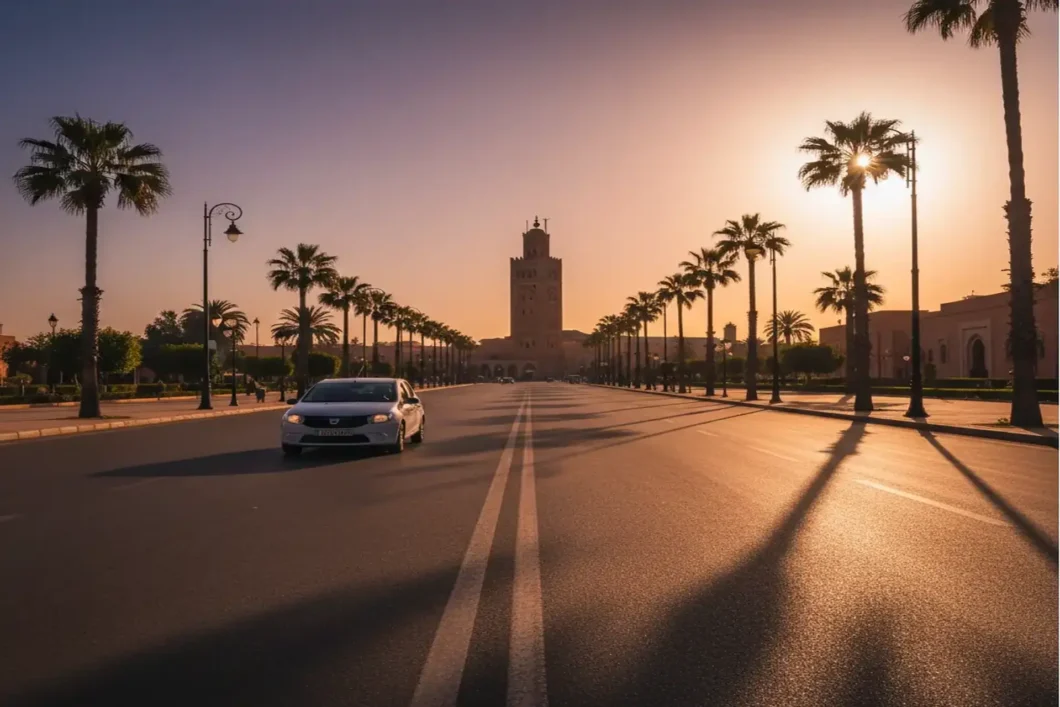
Planning to rent a car in Morocco during Ramadan 2026? Before you book, you need to understand how this holy month transforms everything about driving in Morocco — from rental agency hours to traffic patterns to fuel station availability.
I’ve driven through Morocco during three separate Ramadans, and each time taught me something new about navigating the country when most of the population is fasting from sunrise to sunset. The logistics are different. The traffic is different. Even the rental pickup process is different.
Here’s what most tourists don’t realize: car rental Morocco Ramadan isn’t just about reduced agency hours. It’s about understanding that the entire rhythm of the country shifts for 30 days. Roads empty out at 6 PM as people rush home for Iftar (the evening meal breaking the fast). Fuel stations close during prayer times. Rental staff are fasting, which affects service speed and patience levels.
But here’s the thing — Ramadan driving Morocco is absolutely doable if you adjust your expectations and timing. In fact, rental rates drop 10-20% during this period because it’s low tourist season. You just need to know what you’re getting into.
This guide covers everything: when to drive (and when to absolutely avoid it), how to handle the Iftar traffic rush, which fuel stations stay open, how rental agencies modify their hours, and whether you should even rent a car during Ramadan or take the train instead.
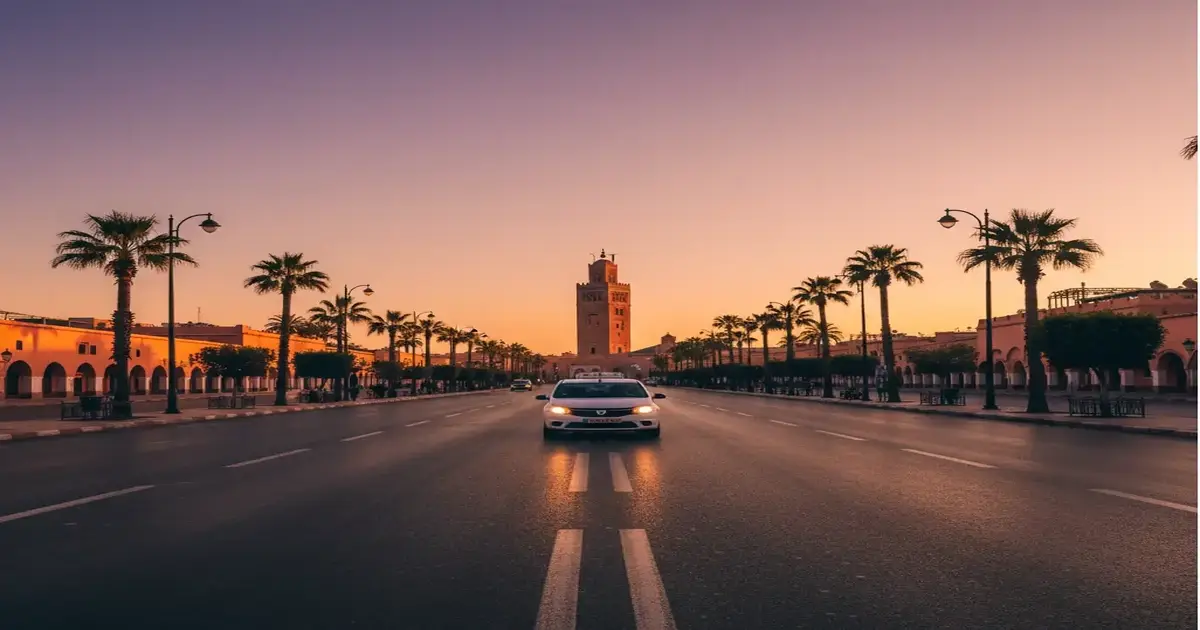
Streets empty dramatically before Iftar as everyone rushes home to break the fast
Ramadan 2026 Dates & Logistics Impact
Ramadan 2026 runs approximately February 18 to March 19. I say approximately because the exact dates depend on moon sighting, which means confirmation comes only 1-2 days before the month begins. For planning purposes, assume the dates above, but be flexible.
That’s 30 full days when Morocco operates on a completely different schedule. If you’re visiting during this period, every aspect of car rental Morocco Ramadan logistics changes.
Why this matters for transport: unlike tourist sites (which mostly stay open) or hotels (which serve meals normally to non-Muslim guests), the car rental and driving experience fundamentally shifts during Ramadan. You’re not just dealing with closed restaurants — you’re dealing with altered human behavior patterns that affect traffic, service speed, and road safety.
Tourist Season Overlap
February-March is already Morocco’s low season. Fewer tourists mean fewer rental cars available (agencies reduce their fleets), but also lower prices and less competition for vehicles. The Ramadan overlap amplifies this — you’ll find deals, but selection is limited.
This is why booking 2-3 weeks ahead becomes essential during Ramadan, even though it’s technically low season. Agencies run skeleton crews with staff rotating fasting schedules, so they can’t handle the vehicle volume they’d manage in high season.
Regional Variations
Marrakech and major cities have more tourists, so you’ll find some restaurants discreetly serving food behind curtains during the day. Rental agencies in tourist zones keep slightly better hours. But rural areas? Everything shuts down completely from sunrise to sunset except essential services.
If you’re planning a Morocco road trip through remote regions during Ramadan, understand that support infrastructure disappears during daylight hours. You’re on your own until sunset.
Rental Agency Operating Hours (The Reality)
This is where Ramadan hits hardest for car rentals. Agencies don’t just reduce hours — they completely restructure their daily schedule around Iftar.
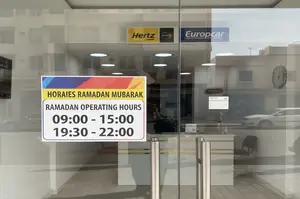
Rental agencies display modified Ramadan hours — always confirm before arrival
| Agency Type | Normal Hours | Ramadan Hours | Impact |
|---|---|---|---|
| Airport desks (Marrakech, Casablanca) | 06:00-23:00 | 08:00-16:00, 20:00-22:00 | Split shift |
| City center agencies | 08:00-19:00 | 09:00-15:00 | 6h reduction |
| Local agencies (Agadir, Fes) | 08:00-18:00 | 09:00-14:00 | Closed at Iftar |
| 24h airport services | Always open | Skeleton staff 16:00-20:00 | Delays likely |
The Iftar Traffic Phenomenon (18:30-19:30)
If you learn nothing else from this guide, learn this: do not drive between 18:00 and 19:00 during Ramadan. This one-hour window is when Morocco’s roads become genuinely dangerous.
Iftar is the evening meal that breaks the fast at sunset. In February, sunset hits around 18:45. By March, it’s around 19:15. This one-hour window before Iftar creates the most dramatic traffic pattern shift you’ll experience anywhere in the world.
The Three Phases of Iftar Traffic
Phase 1: The Empty Streets (18:00-18:30)
Roads become eerily empty. It’s almost post-apocalyptic — highways that are normally packed have maybe 10% of usual traffic. Everyone who possibly can has already left work early and rushed home. The few drivers still on the road are desperate to reach their destination before Iftar.
This is when accidents spike. Drivers are:
Fuel Station Logistics
Fueling up becomes a legitimate planning concern during Ramadan. You can’t just assume you’ll find an open station whenever your tank runs low.
Many fuel stations close during Iftar — plan your refueling carefully
The core problem: Morocco doesn’t have self-service fuel stations. You need an attendant present to pump your gas. And attendants are fasting, which means many stations close during the 17:00-20:00 window so staff can go home for Iftar.
Staffing Patterns
Highway toll road stations (Autoroute stations) usually stay open. These are major facilities that run on rotation schedules even during Ramadan. If you’re on the Marrakech-Casablanca highway or the Rabat-Tangier route, you’re generally safe.
City stations in Marrakech or Casablanca: about 50% stay open during Iftar, but expect reduced staff. You might wait 15-20 minutes for service if multiple cars arrive at once and only one attendant is working.
Small town and rural stations: closed from 17:00 until 20:00 or later. These stations run on one or two family members, and they’re going home for Iftar like everyone else.
Driving Behavior & Road Safety
Understanding how fasting affects driver behavior is crucial for Ramadan road safety Morocco. Different times of day present different risk levels.
Morning Hours (06:00-12:00): The Golden Window
This is your best driving time during Ramadan. Traffic is normal, drivers are fresh (only a few hours into their fast), and road conditions are predictable. If you’re planning a long drive, start early morning. You’ll cover ground safely before the afternoon fatigue sets in for everyone.
I plan all my major driving days during Ramadan to be 06:00-14:00 affairs. Get the distance covered early, arrive at destinations by mid-afternoon, and avoid the entire late afternoon/Iftar situation.
Afternoon (14:00-18:00): Fatigue Increases
By afternoon, drivers have been fasting for 8-10 hours. Dehydration starts affecting judgment and reaction times. You’ll notice:
Services Affected Along Routes
Beyond just driving, you need to understand how Ramadan affects every service you’d normally rely on during a Morocco road trip.
Restaurants and Cafes
Daytime (sunrise to sunset): 90% of restaurants are closed. It’s actually illegal in Morocco to publicly serve food or drink during Ramadan daylight hours. Some tourist restaurants stay open but serve discreetly — curtains drawn, no outdoor seating, you need to ask to be let in.
Major tourist areas (Marrakech medina, Essaouira, Agadir beach) have restaurants that cater to non-Muslim tourists. Look for curtained windows and ask locals which spots stay open. But outside these areas? Forget it. Everything food-related shuts down.
Route Planning Adjustments
Let me show you how Ramadan changes route planning with real examples.
Example: Marrakech → Essaouira (190km, normally 2h45)
Bad plan:
Depart 16:00 → arrive 18:45
Why this fails: You’ll be driving through the pre-Iftar rush hour. The last 45 minutes of your drive coincide with the most dangerous window on Moroccan roads. You’ll also arrive at Essaouira right at Iftar time when your rental drop-off location might be closed and your hotel check-in might be delayed because staff are breaking fast.
Good plan:
Depart 14:00 → arrive 16:45
Why this works: You complete your drive before the traffic surge. You arrive at your hotel with time to check in comfortably before Iftar. The rental agency is still open if you need assistance. You can settle in and then go out after 20:00 to experience Essaouira’s post-Iftar evening scene.
Alternative good plan:
Depart 20:00 → arrive 22:45
Car Return Logistics
Returning your car rental Morocco Ramadan vehicle comes with its own challenges that you don’t face during normal months.
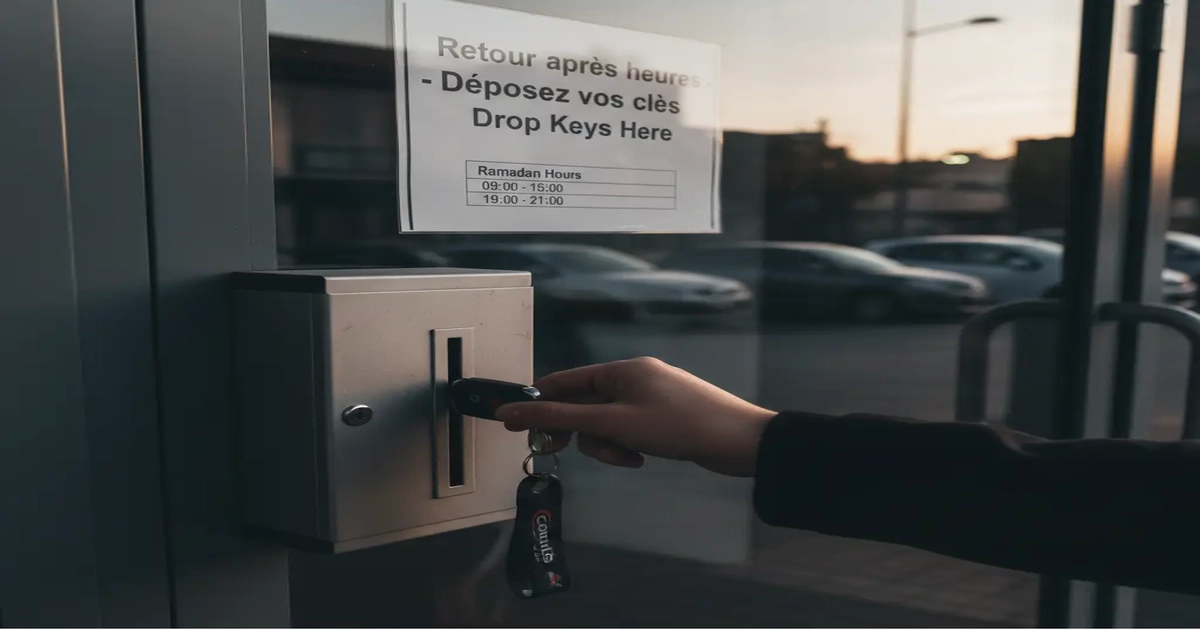
After-hours drop boxes see heavy use during Ramadan Iftar hours
The Iftar Return Problem
Your flight leaves at 20:00, which means you need to return your rental car around 17:30-18:00 to catch your flight. But that’s peak Iftar time when agencies close.
What happens: You arrive at the agency, it’s locked, and there’s a drop box for keys. You leave the keys, rush to catch your flight, and hope everything is fine.
The risk: No staff inspection means no documentation of the vehicle’s condition at return. Two weeks later, you get an email claiming damage that you didn’t cause (or that was pre-existing and never documented at pickup). Now you’re in a dispute about who’s responsible, and you have no proof.
Solutions
Schedule return before 15:00: This guarantees staff presence for proper inspection. Take photos of the vehicle from all angles with timestamps. Get written confirmation that the car was returned in acceptable condition.
Schedule return after 21:00: Most major airport agencies have reopened by then. Staff have eaten, they’re back at work, and you get proper inspection service. The challenge is timing this with your flight schedule.
If forced to use after-hours drop-off:
- Take extensive photos/videos of entire vehicle (exterior, interior, mileage, fuel level) with visible timestamps
- Note any pre-existing damage visible in your photos
- Keep your rental agreement and keys receipt in your files
- Email the agency immediately with your photos confirming vehicle condition at return
This documentation protects you if disputes arise. The agency can’t claim major damage if you have photos showing the vehicle in good condition at return.
Airport Returns vs City Returns
Major airports (Marrakech, Casablanca) maintain better staffing during Ramadan because they can’t simply close for Iftar — international flights don’t stop for Ramadan. These locations are safer bets for returns.
City center agencies often close completely 17:00-21:00. If you’re returning to a city location, confirm hours via email before your trip. Don’t rely on website information — it might not be updated for Ramadan schedules.
Alternative Transport During Ramadan
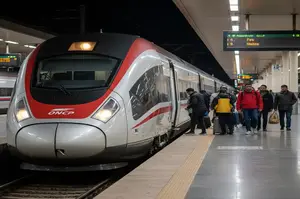
Sometimes the smart move is not renting a car at all during Ramadan. Here’s how other transport methods handle the month.
| Method | Ramadan Impact | Recommendation |
|---|---|---|
| Rental car | Medium (fuel/agency hours) | Viable with planning |
| CTM buses | Low (schedules unchanged) | Best option |
| ONCF trains | Zero (normal service) | Excellent choice |
| Grand taxis | High (drivers fasting/tired) | Avoid 16:00-19:00 |
| Domestic flights | Zero | Normal operations |
Booking Strategy for Ramadan Period
Booking a car rental Morocco Ramadan requires different tactics than booking during normal months.
Do’s
Book 2-3 weeks ahead: Even though it’s low season, agencies run reduced fleets and skeleton staff. Popular vehicle types sell out. Don’t assume you can show up and find a car available.
Confirm agency hours via email: Don’t trust website information alone. Email the specific location where you’ll pick up and ask: “What are your operating hours during Ramadan 2026?” Get written confirmation.
Request pickup before 15:00 or after 21:00: When booking, specify your preferred pickup time in these windows. Agencies appreciate knowing your timing and can staff accordingly.
Choose airport locations: Airport desks maintain better hours and staffing during Ramadan compared to city offices. If you have a choice between airport pickup and downtown, choose airport.
Select full-to-full fuel policy: This is standard in Morocco anyway, but during Ramadan, it’s crucial. You need control over when and where you fuel up. Don’t let the agency dictate your refueling schedule with prepaid fuel options.
Download offline maps: During Ramadan, you’ll have less opportunity to stop and ask for directions (cafes closed, fewer people on streets during the day). Having offline maps on your phone via Maps.me or Google Maps offline mode is essential.
Cultural Logistics (Respectful Travel)
Understanding Ramadan etiquette helps you navigate Morocco Ramadan travel logistics more smoothly and respectfully.
Eating and Drinking in Your Car
Legal for tourists: Morocco’s laws recognize that non-Muslims are not required to fast. You can legally eat and drink in your car during daylight hours.
Cultural sensitivity: Park discreetly rather than eating in front of crowds. Don’t sit at a stoplight with the window down eating a sandwich in full view of fasting pedestrians. It’s legal but insensitive.
My approach: I eat and drink while driving on highways where I’m not stopped near people. When I’m in town traffic, I keep food out of sight until I’m moving again. It’s a small adjustment that shows respect for others’ religious practice.
Smoking While Driving
Legal, but consider context. Some Moroccans give up smoking during Ramadan as part of their fast (not required religiously, but a personal choice). If you smoke while driving, keep windows closed when stopped at lights. It’s a courtesy to those around you who might be fasting from smoking too.
Music Volume
Lower your music near mosques during prayer times. Five times a day, calls to prayer echo across Morocco. It’s respectful to turn down your car stereo when passing mosques during these times. You’ll hear the call to prayer — just lower the volume for those few minutes.
Patience at Checkpoints
Officers might be fasting, which affects their energy levels and patience. If document checks seem to take longer or if officers are less friendly than you’d expect, understand the context. They’ve been working all day without water or food. A smile and patience from you goes a long way.
What Still Works Normally
Tourist sites: Open normal hours. You can visit the Bahia Palace, wander Fes medina, explore Ait Benhaddou all day long during Ramadan.
Hotels: Full service continues. Your hotel will serve you breakfast, lunch, and dinner as normal. Room service works. This is your reliable food source.
Supermarkets: Open, though many close 18:00-19:30 for Iftar. Stock up on snacks and water in the morning or early afternoon.
Pharmacies: Normal hours. If you need medication or supplies, pharmacies maintain regular schedules.
The Cost-Benefit Analysis
Let’s talk money and practicality. Should you actually rent a car in Morocco during Ramadan?
Rent a Car IF:
You’re traveling to remote areas trains and buses don’t reach. The Atlas Mountains, Sahara desert camps, coastal villages between Essaouira and Agadir — these places require a car regardless of Ramadan.
You’re doing a multi-stop road trip where flexibility matters. If your itinerary includes 5-6 different stops over 10 days, a car gives you control over timing and routing that public transport can’t match.
You’re traveling as a group of 3+ people. Cost splits favorably when you have multiple people sharing rental and fuel costs. A 500 MAD/day rental becomes 125 MAD per person for a group of four.
You’re comfortable driving in altered conditions. If you’ve driven in developing countries before, understand defensive driving, and can adjust to Ramadan’s rhythm, you’ll be fine.
Use Trains/Buses IF:
You’re doing city-to-city travel. Marrakech to Fes, Casablanca to Tangier, Rabat to Marrakech — these routes are better by train during Ramadan. Faster, cheaper, no stress.
You’re a solo traveler. The cost advantage of trains is huge when you’re not splitting rental expenses. Plus you avoid navigation, driving fatigue, and parking hassles.
You want to avoid Iftar traffic stress. If the idea of timing drives around sunset prayer and traffic patterns sounds exhausting, trains eliminate this entirely.
This is your first time in Morocco during Ramadan. Learn the rhythms of the country as a passenger first. You can always rent a car on your next trip once you understand how Ramadan works.
Price Impact
Rental rates: 10-20% lower than high season. February-March is already cheap, and Ramadan reduces tourist demand further. A car that costs 400 MAD/day in April might be 320 MAD/day during Ramadan.
Fuel costs: Unchanged. Diesel and gasoline prices don’t fluctuate based on Ramadan. You’ll pay standard rates (currently around 12 MAD/liter for gasoline).
Time cost: +15-20% more time needed. Everything takes longer — agency pickups, fuel stops, getting services. A trip that normally takes 8 hours of driving plus stops might take 9-10 hours during Ramadan when you factor in agency delays, fuel station waits, and avoiding Iftar traffic.
Value assessment: The money you save on lower rental rates (50-80 MAD/day) is partially offset by the extra time and planning required. For many travelers, this is still worth it — Morocco in February is beautiful, crowds are minimal, and the experience of seeing the country during Ramadan is unique.
Final Verdict: Ramadan Car Rental Strategy
After three Ramadans driving through Morocco, here’s my honest take: car rental Morocco Ramadan is absolutely workable, but it requires more planning and flexibility than normal months.
The advantages are real: lower prices, fewer tourists, unique cultural experience, and the profound beauty of experiencing Morocco during its holiest month. Driving through empty pre-Iftar streets and then watching cities come alive after sunset gives you a perspective on Moroccan life that you’d never see as a summer tourist.
The challenges are also real: reduced services, altered schedules, navigation without cafe stops for breaks, and the need to constantly plan around Iftar timing. You can’t just wing it during Ramadan — every drive needs thought about fuel stops, timing, and meal planning.
My recommendation:
Rent a car if your itinerary requires it (remote destinations, multi-stop flexibility) and you’re comfortable with extra planning. Drive early mornings, avoid the 18:00-19:00 window religiously, pack provisions, and adjust your expectations for service speed.
Take trains or buses if you’re doing straightforward city-to-city routes. The stress reduction and cost savings often outweigh the flexibility a car provides, especially during Ramadan when that flexibility comes with more complications.
Either way, approach Ramadan travel with cultural respect and patience. Morocco during Ramadan is a special experience — different from normal months, but not worse. Just different. And if you adjust your approach, you’ll find that exploring Morocco during this month offers rewards that more than justify the extra planning.
Book smart, drive safe, and respect the rhythm of the month. Ramadan travel in Morocco is one of those experiences that separates casual tourists from real travelers — and if you’re reading this guide, you’re clearly in the latter category.