

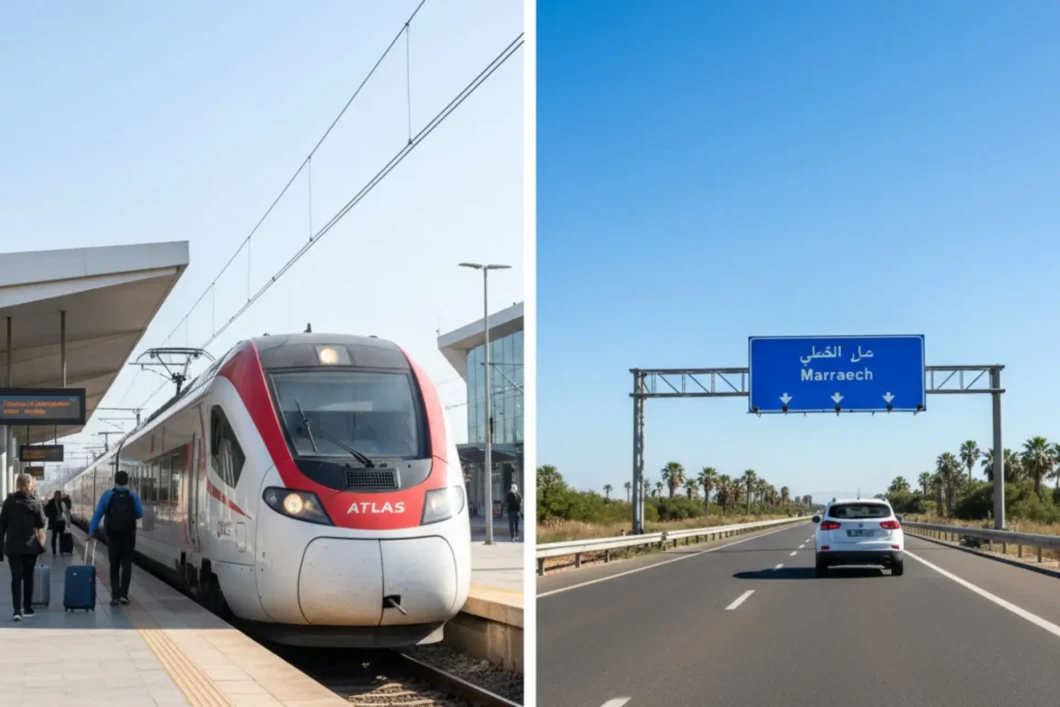
The 240-kilometer journey between Morocco’s economic powerhouse and its tourism crown jewel is one of the country’s most traveled routes. Whether you’re chasing the chaos of Marrakech’s souks or making your way from the coast to the desert, understanding your transport options can make or break your Moroccan adventure.
Here’s the thing most guidebooks won’t tell you: there’s no single “best” way to travel from Casablanca to Marrakech. Your ideal choice depends on your budget, schedule, comfort preferences, and what comes next in your itinerary. A backpacker hopping between cities has different needs than a family heading to the Atlas Mountains or a business traveler with a tight schedule.
In this guide, we’re breaking down every transportation option — from the modern **Al Boraq train connection** to the freedom of driving the A3 highway, to the budget-friendly bus routes. We’ll cover the logistics, the real costs, the pros and cons, and the insider tips you won’t find on official booking sites.
The Route Overview: The 240km Corridor
The journey between Casablanca and Marrakech connects Morocco’s two most contrasting urban centers. Casablanca — often called “Casa” by locals — serves as the nation’s economic engine, a sprawling port city where business suits outnumber djellabas and glass towers compete with colonial-era architecture. It’s Morocco’s largest city, home to the Hassan II Mosque and a decidedly modern, cosmopolitan vibe.
Marrakech, by contrast, is Morocco’s tourism jewel. The medina’s chaotic souks, the snake charmers of Jemaa el-Fna, the palatial riads hidden behind nondescript doors — this is the Morocco that fills Instagram feeds and travel fantasies. It’s also the gateway to the Atlas Mountains and the Sahara desert beyond.
The distance between these two poles? Approximately 240 kilometers (149 miles) as the crow flies, though the actual travel distance varies slightly depending on your route and mode of transport.
The Al Boraq Factor: Morocco’s High-Speed Rail Reality
In 2018, Morocco launched Africa’s first high-speed rail line, Al Boraq (named after the winged creature from Islamic tradition). The sleek trains can hit speeds of 320 km/h, cutting travel times dramatically between Tangier and Casablanca. Here’s what matters for travelers in 2025:
The **Al Boraq high-speed line** currently terminates at Casablanca. The Casablanca-Marrakech segment still uses the conventional **Atlas train** — a rapid, comfortable service, but not the futuristic bullet train experience you might expect. You’re looking at speeds around 120-160 km/h on this leg, not 320 km/h.
That said, there’s talk of extending the high-speed line all the way to Marrakech by the late 2020s, which would reduce journey times to under 1 hour 30 minutes. For now, the train Casablanca to Marrakech journey takes approximately 2 hours 40 minutes — still fast, comfortable, and hassle-free compared to road options.
Option 1: The Train (The Balanced Choice)
For most travelers, the ONCF train from Casablanca to Marrakech hits the sweet spot between speed, comfort, and convenience. It’s Morocco’s most developed rail route, with frequent departures and a reliable schedule that works whether you’re an early riser or prefer a midday departure.
The Logistics: Stations and Schedules
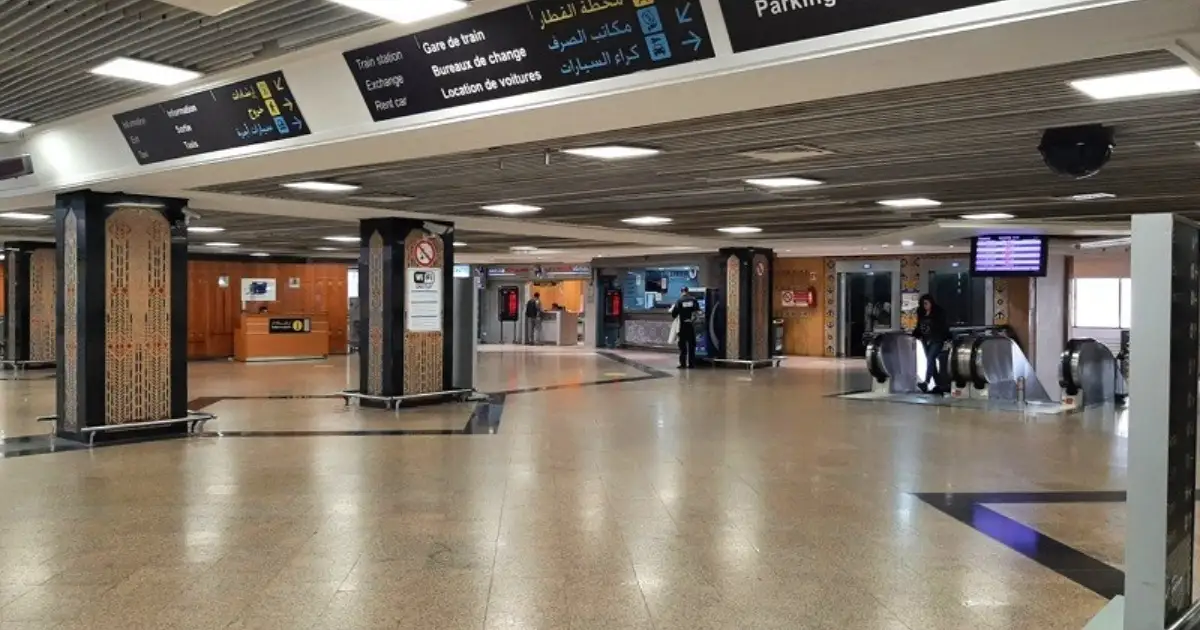
Your journey will typically start at **Casa Voyageurs** (Casablanca Voyageurs station), located in the Maarif district, about 4 kilometers south of the city center. Don’t confuse this with Casa Port station, which handles primarily local and commuter trains. If you’re arriving at Mohammed V Airport, you’ll take a connecting train (about 30 minutes) to Casa Voyageurs first.
Trains depart **almost every hour** throughout the day, from around 6:00 AM to 10:00 PM. Peak times (morning and early evening) see even more frequent service. The journey ends at **Marrakech Ville station**, conveniently located just outside the medina walls — a short 10-15 dirham taxi ride to most riads and hotels.
Travel time: Approximately 2 hours 40 minutes for direct services. Some trains make additional stops at Settat and Ben Guerir, adding 15-20 minutes to the journey.
Classes and Comfort
ONCF offers two classes on this route:
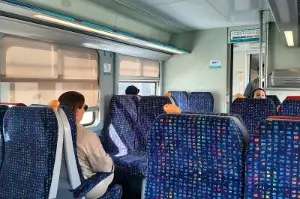
**First Class (Première Classe):** Spacious 2+2 seating in air-conditioned carriages, with reclining seats, footrests, and noticeably more legroom. Think comfortable airplane business class. Perfect for working on a laptop or catching up on sleep. Tickets run around 140-150 MAD (approximately $14-$15 USD).
**Second Class (Deuxième Classe):** Still comfortable, but with 2+3 seating configurations and less legroom. Also air-conditioned. Expect more crowding during peak times, though the journey is short enough that it’s rarely uncomfortable. Tickets typically cost 90-100 MAD (approximately $9-$10 USD).
Here’s the insider tip: If you’re traveling mid-week and outside rush hours, second class is perfectly fine and you’ll save 40-50 dirhams. On weekends, holidays, or if you value working space, the first class upgrade is worth every dirham.
Booking Your Train Ticket
You can book train tickets Casablanca to Marrakech several ways:
- **ONCF Website:** The official site (oncf.ma) allows online booking with payment by credit card. Tickets can be printed at home or shown on your phone. The interface can be clunky, but it works.
- **At the Station:** Ticket windows open early and close late. You can buy tickets on the day of travel, though peak times and weekends may see sellouts on first class. There are also automated kiosks that accept credit cards.
- **Travel Apps:** Apps like Trainline aggregate schedules and sometimes offer better interfaces than the official ONCF site.
**Pro tip:** If you’re staying in central Casablanca, give yourself 30-40 minutes to reach Casa Voyageurs by taxi or tram. Don’t cut it close — trains depart on time, and Moroccan traffic can be unpredictable.
The Airport Connection
If you’re arriving at Mohammed V International Airport (CMN) and heading straight to Marrakech, here’s the most efficient route:
- From the airport terminal, follow signs to the **train station** (it’s directly connected to Terminal 1)
- Take the airport shuttle train to **Casa Voyageurs** (trains run every 30-60 minutes, journey time: 30 minutes, cost: around 50 MAD)
- At Casa Voyageurs, transfer to a Marrakech-bound train
Option 2: Driving the Highway (The Freedom Choice)
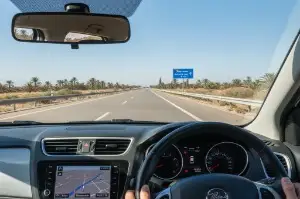
If you value flexibility, plan to explore beyond the main cities, or are traveling as a family or group, **driving from Casablanca to Marrakech** opens up possibilities that public transport simply can’t match. Morocco’s A3 autoroute between the two cities is one of the country’s best highways — well-maintained, clearly marked, and relatively stress-free by Moroccan standards.
The Route: The A3 Autoroute
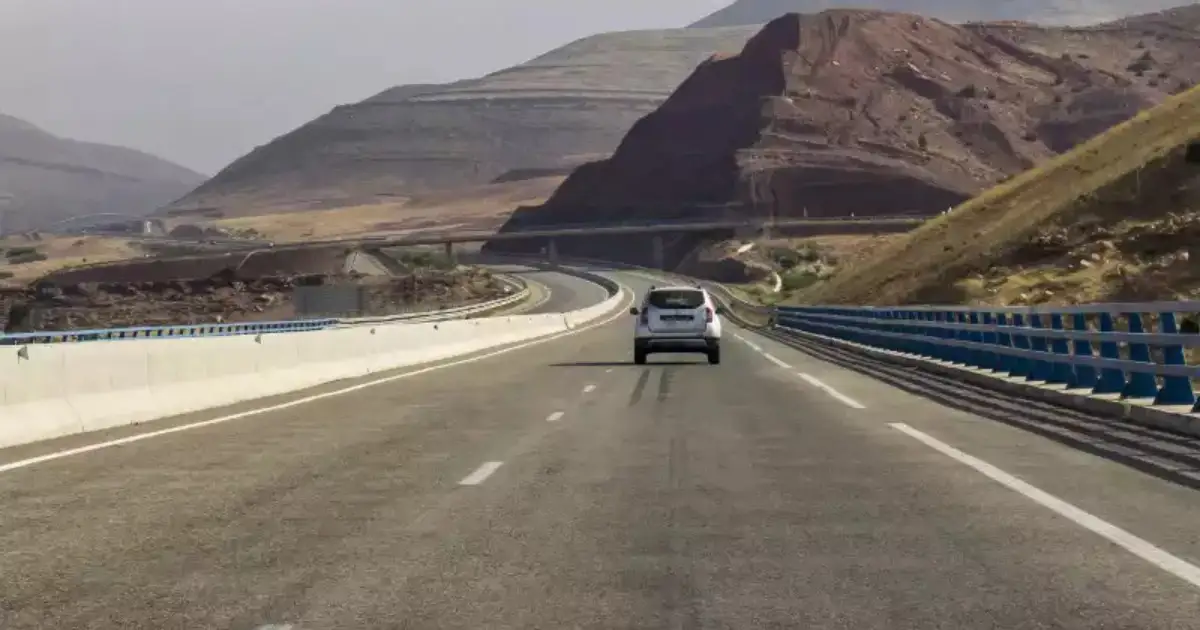
The journey follows the **A3 highway**, Morocco’s busiest autoroute, for the entire distance. Unlike some of the country’s rural roads, this is a modern, European-standard freeway with two lanes in each direction, regular rest stops, and 24/7 emergency services.
**Distance:** Approximately 240-245 kilometers, depending on your exact start and end points within each city.
**Driving time:** Under ideal conditions, expect 2 hours 15 minutes to 2 hours 30 minutes. However, factor in Casablanca traffic getting out of the city (which can add 30-45 minutes during rush hour) and finding parking in Marrakech. Realistically, budget 3 to 3.5 hours door-to-door.
Tolls and Fuel Costs
The A3 is a toll road (autoroute à péage). You’ll encounter several toll booths along the route. As of 2025, the total toll cost from Casablanca to Marrakech is approximately 80-100 MAD ($8-$10 USD), depending on your vehicle class. Tolls accept both cash (dirhams only) and credit cards at most booths.
**Fuel costs:** Gasoline in Morocco runs around 13-14 MAD per liter (approximately $5.20-$5.60 per gallon). For a typical rental car getting 6-7 liters per 100km, you’re looking at roughly 180-200 MAD ($18-$20 USD) in fuel for the round trip.
**Total driving cost for a round trip:** Approximately 450-550 MAD ($45-$55 USD) including tolls and fuel. If you’re traveling as a couple or family, this becomes more cost-effective than multiple train tickets.
Rest Stops and Services
- **Casablanca traffic stress:** Getting out of Casa, especially during rush hour, can be aggravating
- **Driver responsibility:** One person stuck driving while others relax (unless you split shifts)
- **Parking hassles:** Finding parking in Marrakech, especially near the medina, can be challenging and expensive
- **Costs add up:** Between rental, insurance, fuel, and tolls, solo travelers pay more than the train
- **Navigation:** Even with GPS, Moroccan roads can be confusing. Highway is easy, but city navigation less so
Who Should Drive?
Driving makes sense for families, groups of 3-4+, anyone planning an extended Morocco road trip, or travelers who value flexibility over convenience. It’s also ideal if your itinerary includes stops in the Atlas Mountains, desert towns like Ouarzazate, or coastal Essaouira — destinations not well-served by train.
Option 3: The Bus (The Budget Choice)
For travelers prioritizing budget over speed, the **bus from Casablanca to Marrakech** offers a rock-bottom price and comfortable-enough journey. Morocco has several bus companies operating this route, but for tourists, there are really only two worth considering: **CTM** and **Supratours**.
CTM vs Supratours: Which Bus Company?
**CTM (Compagnie de Transports au Maroc)** is Morocco’s largest and most established bus company, with a reputation for reliability and comfort. Think of it as Morocco’s Greyhound. CTM buses are modern, air-conditioned coaches with reclining seats, onboard bathrooms, and sometimes WiFi (though connectivity is hit-or-miss).
**Supratours** is owned by ONCF (the national railway) and designed to complement train routes. Their buses connect railway stations to destinations not served by trains. The quality is comparable to CTM — clean, modern buses with good service.
**Avoid local/regional bus companies** for this route. While locals use them without issue, they’re typically older vehicles, less comfortable, with less reliable schedules and no air conditioning. For a 3+ hour journey, the small savings aren’t worth the discomfort.
Schedules and Journey Time
Both CTM and Supratours run multiple daily departures between Casablanca and Marrakech, typically every 1-2 hours from early morning through evening.
**Journey time:** Expect 3 hours 30 minutes to 4 hours for the direct bus. This is notably slower than the train (2h40m) or driving (2h15m in ideal conditions) because buses make more stops, deal with city traffic at both ends, and don’t have dedicated rail lines.
**Departure points in Casablanca:**
- **CTM:** Main station at Boulevard Ziraoui in central Casablanca, near Casa Port. There’s also a major CTM terminal in the Sidi Maarouf neighborhood, which serves long-distance routes.
- **Supratours:** Typically departs from near Casa Voyageurs train station, making it convenient for connections.
**Arrival in Marrakech:** Both companies arrive at Marrakech’s main bus station (Gare Routière), located near Bab Doukkala gate, about 2 kilometers northwest of Jemaa el-Fna square. You’ll need a taxi (15-20 MAD) to reach most accommodations in the medina.
Booking and Prices
**Cost:** CTM and Supratours tickets for the **Casablanca to Marrakech bus** route cost approximately 90-120 MAD ($9-$12 USD) one-way. This is the cheapest option, roughly equivalent to a second-class train ticket but with a longer journey time.
**How to book:**
- **Online:** CTM has a functional website (ctm.ma) where you can book and pay by credit card. Supratours can be booked through the ONCF site. Print your ticket or show the mobile confirmation.
- **At the station:** Ticket windows open early and close late. Buying on the day of travel is usually fine except during major holidays (Eid, Ramadan, summer peak season).
- **Through your accommodation:** Many riads and hotels can book CTM tickets for a small service fee.
**Pro tip:** Book at least a day ahead during weekends and holidays. Popular departure times (early morning, late afternoon) can sell out.
What to Expect on the Bus
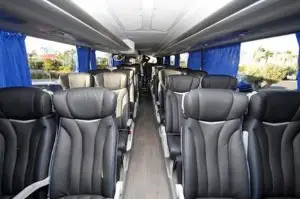
CTM and Supratours buses are surprisingly comfortable for the price. Air conditioning works (maybe too well — bring a sweater), seats recline moderately, and there’s an onboard bathroom (don’t expect luxury, but it’s functional).
Buses typically make one rest stop midway through the journey, usually at a roadside café or rest area. This gives you a chance to stretch, use better facilities, and grab a coffee or snack. The stop lasts 10-15 minutes — don’t wander off or you’ll be left behind.
Luggage is stored in the lower compartment, with a ticket/tag system. Keep valuables and electronics in your carry-on bag.
The Pros of Taking the Bus
- **Cheapest option:** At 90-120 MAD, it’s hard to beat the price
- **No driving stress:** Let someone else handle Moroccan traffic
- **Comfortable enough:** Modern CTM/Supratours buses are clean and air-conditioned
- **WiFi (sometimes):** Newer buses advertise WiFi, though don’t count on it working reliably
- **Frequent departures:** Multiple daily options give flexibility
- **Good for solo budget travelers:** Train second class is similar price, but bus saves a bit
The Comparison: Which Option is Best for You?
So — train, car, or bus? The answer depends on your specific situation. Here’s a quick comparison to help you decide:
| Feature | Train (ONCF) | Driving (A3 Highway) | Bus (CTM/Supratours) |
|---|---|---|---|
| Travel Time | ~2h 40min | ~2h 15min (+ traffic) | ~3h 30min – 4h |
| One-way Cost | 90-150 MAD ($9-$15) | 350+ MAD fuel+tolls+rental | 90-120 MAD ($9-$12) |
| Comfort Level | High (especially 1st class) | Variable (you control it) | Moderate (CTM/Supratours) |
| Flexibility | Limited to schedule | Complete freedom | Limited to schedule |
| Frequency | Every 1-2 hours | Anytime you want | Every 1-2 hours |
| Best For… | Solo/couples, city-hopping | Families, groups, road trips | Budget travelers, backpackers |
| Luggage Space | Limited overhead/floor | Unlimited (trunk space) | Check-in luggage hold |
| Stops/Detours | None (direct to Marrakech) | Stop anywhere, anytime | One rest stop midway |
The Pro’s Recommendation: Making the Smart Choice
After years of traveling this route and helping hundreds of visitors plan their Morocco adventures, here’s our honest take:
Take the Train If…
- You’re traveling solo or as a couple
- You value convenience and time efficiency
- You’re doing a multi-city tour (Casablanca → Marrakech → Fes, etc.)
- You don’t plan to visit remote areas requiring a car
- You’re arriving at Mohammed V Airport and heading straight to Marrakech
- You want to work or relax during transit rather than driving
**The train is the best all-around choice for most tourists.** It’s fast, comfortable, affordable, and stress-free. First class gives you space to work or relax, and the convenience of city-center stations can’t be beaten.
Drive If…
- You’re traveling as a family or group of 3+
- Your itinerary includes Atlas Mountains, Sahara desert, or coastal towns
- You value flexibility and want to explore beyond main tourist routes
- You’re comfortable with driving in Morocco
- You have lots of luggage or equipment (surfboards, camping gear, etc.)
- You want to do a comprehensive Morocco road trip
**Driving makes sense when your journey doesn’t end in Marrakech.** If you’re planning to head to Essaouira, the Dades Valley, or Merzouga, having a car from the start eliminates the hassle of renting in Marrakech later.
Take the Bus If…
- Budget is your absolute top priority
- You don’t mind longer travel times
- You’re backpacking and traveling light
- Trains are sold out (rare, but happens during holidays)
**The bus is fine, but not our first recommendation.** Unless you’re pinching every dirham, the small savings over the train don’t justify the extra hour of travel time and reduced comfort.
The Airport Factor: Coming from Mohammed V
If you’re landing at Casablanca’s Mohammed V International Airport (CMN) and Marrakech is your first destination, here’s the most efficient route:
- **Best option:** Take the airport shuttle train to Casa Voyageurs (30 minutes, 50 MAD), then connect to a Marrakech-bound train. Total time: 3-3.5 hours. This is far easier than dealing with Casa traffic in a taxi.
- **Alternative:** Some travelers book a private transfer (shared or private van) directly from the airport to Marrakech. Costs run 400-800 MAD per person for shared transfers, 1500-2000 MAD for a private vehicle. This saves the hassle of connections but is significantly more expensive.
- **Not recommended:** Taking a taxi from the airport to Marrakech. Drivers will quote 1500-2000 MAD and you’re at the mercy of their driving. Train is cheaper, safer, and more comfortable.
The Night Travel Question
Can you travel between Casablanca and Marrakech at night? Technically yes, but with caveats:
**Night trains:** ONCF runs evening trains (last departure around 10 PM) and early morning trains (first departure around 6 AM). These are safe and fine to take.
**Night driving:** The A3 highway is one of Morocco’s few roads where night driving is relatively safe due to lighting and maintenance. However, Casablanca traffic at night can still be chaotic, and arriving in Marrakech after dark makes finding your riad unnecessarily difficult. If you must drive at night, be extra cautious and consider having your riad arrange a meeting point with a guide.
**Night buses:** CTM runs evening departures, arriving in Marrakech by 11 PM or midnight. This is fine, though again, navigating to your accommodation in the dark can be tricky.
**Our advice:** Plan to arrive in Marrakech before dark, at least for your first visit. The medina is confusing enough in daylight.
Final Thoughts: Connecting Morocco’s Two Heartbeats
The journey from Casablanca to Marrakech is more than just getting from point A to point B — it’s your first glimpse of Morocco’s diversity. As the urban sprawl of Casa fades behind you and the first hints of the Atlas Mountains appear on the horizon, you’re witnessing the country’s transformation from economic center to cultural soul.
Whether you choose the efficiency of the **train from Casablanca to Marrakech**, the freedom of the open road, or the budget-friendly bus, you’re following a route that thousands of travelers have taken before you. Each option has its merits. The train offers the sweet spot of comfort and convenience. Driving opens up detours and adventures off the main route. The bus stretches your budget further.
The best choice? The one that aligns with your travel style, budget, and what comes next in your Moroccan journey. And now you have all the information to make that choice confidently.
Safe travels, and welcome to Marrakech. The chaos of Jemaa el-Fna, the scent of tagines simmering in the souks, and the pink glow of sunset over the medina await you.
Bon voyage!