

Most travelers arrive in Morocco excited to explore the winding roads through the Atlas Mountains, the scenic coastal drives, and the desert highways. But there’s one piece of advice that seasoned drivers in Morocco will universally give you: avoid driving at night. Here’s why this isn’t just cautious advice—it’s a survival imperative.
When you’re planning your Morocco road trip logistics, understanding the specific dangers of nighttime driving can literally save your life. The risks aren’t theoretical. They’re real, documented, and preventable if you plan your driving schedule appropriately.
The “Invisible” Hazards: Unlit Vehicles
This is the number one risk when driving at night in Morocco, and it’s something that catches even experienced drivers off guard.
The Reality on Moroccan Roads
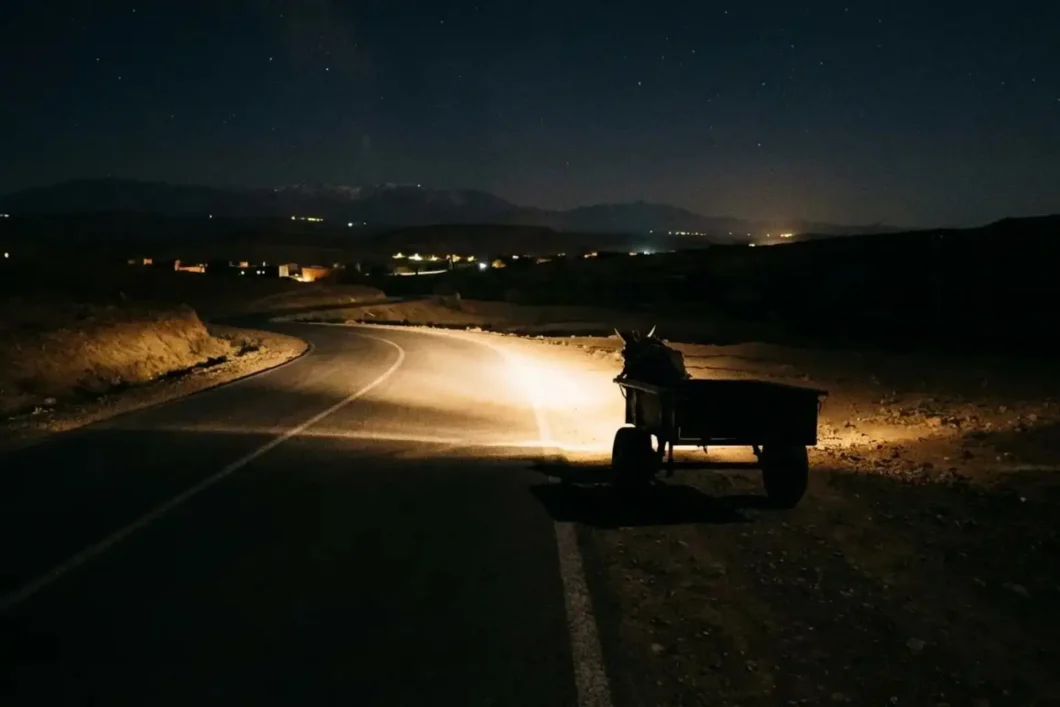
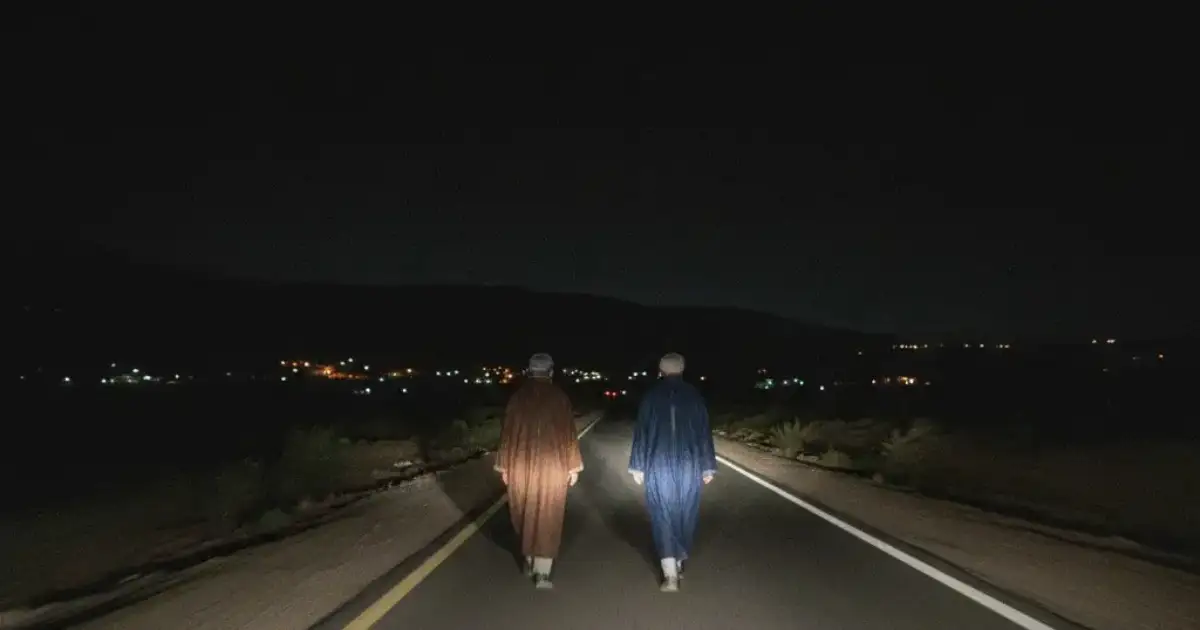
A significant number of rural vehicles in Morocco don’t have functioning rear lights. Period. We’re not talking about dim lights or old bulbs—we’re talking about complete absence of any illumination. You might be cruising along a national road at 100 km/h (the legal speed limit), and suddenly encounter a donkey cart moving at 15 km/h with zero warning lights.
Picture this: You’re driving through the Dadès Valley after sunset. The road ahead looks clear. Your headlights illuminate maybe 50 meters ahead. Then, at the last possible second, you see the dark silhouette of an old truck loaded with hay, barely crawling along without a single functioning light. By the time you register what you’re seeing, you have seconds to react.
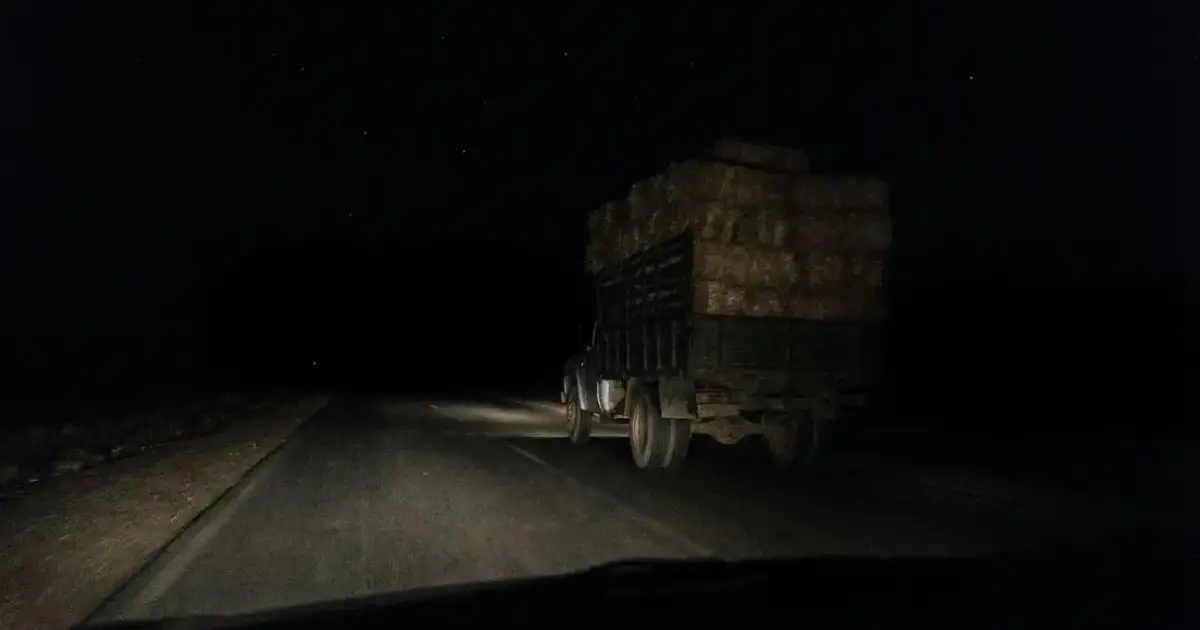
The logistics of this hazard are straightforward but deadly. Rural Morocco relies heavily on agricultural transport—tractors, pickup trucks carrying livestock, horse-drawn carts, and yes, donkey carts. Many of these vehicles are decades old. Electrical systems fail. Bulbs burn out. And in rural areas, replacing a taillight isn’t a priority when the vehicle is primarily used for short trips between villages during daylight hours.
What This Means for You
When you’re driving in Morocco, especially on routes outside major cities, you need to assume that any slow-moving vehicle ahead might be completely invisible until you’re dangerously close. The standard “follow at a safe distance” rule doesn’t apply when you can’t see what you’re supposed to be following.
Professional drivers in Morocco have developed a technique: they watch for the absence of stars. Sounds strange? At night in rural areas, if there’s a section of sky where you can’t see stars, there might be a large, unlit vehicle blocking your view. It’s not foolproof, but it’s an additional data point.
High-Beam Warfare: The Blinding Effect
Even when vehicles do have functioning lights, the way they’re used creates another layer of danger unique to Moroccan roads.
The Cultural Context
There’s a driving habit in Morocco—keeping high beams on until the absolute last moment when meeting oncoming traffic. Some drivers don’t dim at all. Others have installed aftermarket LED light bars that are incredibly bright but not properly aimed or road-legal in most countries. The result? Temporary but complete blindness for several seconds after an oncoming vehicle passes.
The “Black Hole” Effect
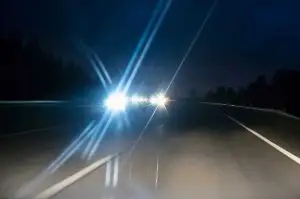
Here’s the physics of what happens: Your eyes are adapted to the relative darkness of nighttime driving, with your pupils dilated to let in maximum light. Then suddenly, an incredibly bright light source (high beams or LED bars) hits you directly. Your pupils contract instantly to protect your retinas.
For the next 3-8 seconds after that vehicle passes, your vision is severely compromised. You literally cannot see what’s immediately in front of you. Your headlights are still working, but your eyes haven’t re-adjusted. During this “black hole” period, you might not see a pedestrian on the roadside, a broken-down vehicle, or an animal crossing.
Now multiply this by 50-100 vehicles per hour on a busy national road. You’re being temporarily blinded every minute or two, for hours. The mental and visual fatigue is exhausting, and your reaction time degrades significantly.
Defensive Tactics
The Loading and Unloading Zone
Trucks and vans often stop on the road itself to load or unload goods. Not on the shoulder—on the actual traveled lane. Sometimes with no warning triangles, no flares, just a dark vehicle partially blocking the road. In cities, this happens during the day and you learn to expect it. On rural roads at night, it’s a recipe for a collision.
Road Infrastructure and Mental Fatigue
The quality of road infrastructure in Morocco varies dramatically, and these variations become much more dangerous at night.
Tow trucks in rural Morocco aren’t sitting idle waiting for calls. They might be in their garage, at home, or handling another job. Response times of 2-4 hours are common. In remote areas, it could be longer. You’re spending your night on the side of a dark road, in an unfamiliar area, waiting.
If you’ve had an accident involving another vehicle or livestock, you’re also dealing with potential police involvement. The procedures are different from what most Western travelers expect. Police reports can take hours to complete, especially if there’s language barriers or disputes about fault.
Medical Emergency Complications
In the event of injuries, ambulance services in rural areas are limited and response times can be very slow. Serious injuries might require transport to a hospital in a larger city, potentially hours away. The medical infrastructure in rural Morocco, while improving, isn’t equipped for major trauma cases in most locations.
This isn’t meant to create panic—Morocco is a safe country to visit and travel in Morocco is generally very rewarding. But understanding these logistics helps you make informed decisions about when and where to drive.
The Bottom Line: Is Night Driving Ever Acceptable?
After laying out all these hazards, the question remains: can you ever safely drive at night in Morocco?
The honest answer is that it depends on several factors. The toll autoroutes between Casablanca, Rabat, Marrakech, and Tangier are reasonably safe at night. They’re well-lit in sections, well-maintained, and livestock is largely absent. Traffic is predictable, and assistance is accessible. If you absolutely must drive at night, stick to these routes.
For all other roads—the scenic mountain routes, the desert highways, the coastal roads, the rural connections between cities—the risks outweigh any time-saving benefits. The professionals who drive these roads for a living (bus drivers, truck drivers, tour guides) almost universally avoid nighttime travel when possible. That should tell you something.
Planning Your Itinerary
When you’re working out your Morocco road safety tips and travel schedule, build in enough time to reach your destination before sunset. Sunset in Morocco varies by season but generally occurs between 5:30 PM (winter) and 8:00 PM (summer). Factor in at least a 30-minute buffer before dark.
If you’re running late and sunset is approaching, the smart move is to find accommodation in the nearest town rather than pushing through. Yes, it might disrupt your plans. But it’s infinitely preferable to the alternatives.
What About Emergencies?
Sometimes night driving becomes necessary due to emergencies—a family member’s illness, a flight you can’t miss, a situation beyond your control. If you find yourself in this position, take these precautions seriously. Reduce your speed by at least 30% compared to daytime. Use your high beams when there’s no oncoming traffic, but be ready to dim instantly. Increase following distance to at least 5 seconds. Stop completely if you encounter livestock on or near the road—don’t try to navigate around them. And stay extremely alert—no phone use, no distractions, minimal conversation with passengers.
These aren’t just suggestions. They’re the difference between arriving safely and becoming a statistic in Morocco’s road accident data.
Final Thoughts: Respect the Local Wisdom
There’s a reason why Moroccans themselves avoid driving at night when possible. It’s not paranoia or overcautiousness—it’s accumulated wisdom from decades of experience on these roads. The hazards of night driving Morocco presents are real, documented, and preventable through simple planning.
Your Morocco adventure should be memorable for the right reasons—the stunning landscapes, the incredible food, the warm hospitality, the ancient medinas. It shouldn’t be remembered for a terrifying near-miss with an unlit donkey cart or, worse, an actual collision.
Plan your routes. Build in time cushions. Respect sunset as a hard deadline. And if anyone asks you “Is it safe to drive from Marrakech at night?”—whether it’s to Essaouira, to Merzouga, or to anywhere else—you now know the answer. Technically possible? Yes. Advisable? Absolutely not.
The roads of Morocco are spectacular, rewarding to drive, and completely worth experiencing. Just do it when you can actually see them properly. Your safety, and the safety of everyone else on the road, depends on it.