


Grand Taxis in Morocco: The Essential Traveler’s Guide
Ah, Morocco! The land of vibrant souks, stunning landscapes, and… chaotic transportation? If you’ve spent any time researching how to get around Morocco, you’ve probably come across the term “Grand Taxi” and wondered what on earth that means.
Well, let me tell you – after taking countless Grand Taxi rides across Morocco, from the bustling streets of Marrakech to remote mountain villages, I’ve learned everything there is to know about this quintessential Moroccan travel experience. And trust me, once you understand how they work, Grand Taxis become your secret weapon for authentic, affordable travel across this beautiful country!
In this comprehensive guide, I’ll walk you through everything you need to know about Grand Taxis in Morocco – from finding them to negotiating fares, staying safe, and even some essential Darija phrases that’ll make your rides smoother. Ready to become a Grand Taxi pro? Let’s dive in!
🚗 Understanding Moroccan Transport: What Exactly is a Grand Taxi?
The Grand Taxi Definition
So what makes a Grand Taxi “grand”?
Grand Taxis are inter-city shared taxis that connect cities, towns, and rural villages across Morocco. Unlike their smaller cousins (Petit Taxis, which I’ll explain later), Grand Taxis are authorized to travel between cities and are the economic lifeline for countless Moroccans traveling to work, visit family, or reach remote areas.
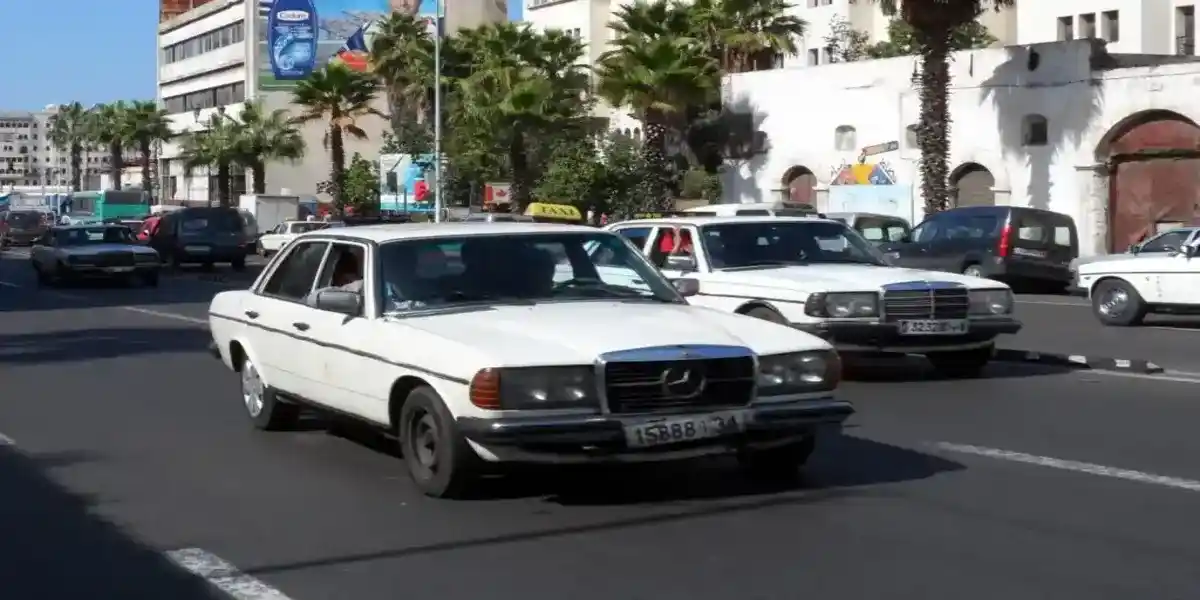
The typical Grand Taxi is an older Mercedes sedan – usually painted white or cream-colored, though this varies by region. And when I say “older,” I mean it! Many of these vehicles have been faithfully serving travelers for 20+ years. They’re iconic, they’re everywhere, and they’re an absolute must-try experience if you want to travel like a local.
The most distinctive feature? Grand Taxis operate on a shared basis, cramming up to 6 passengers into a single vehicle. Yes, you read that right – six people in a sedan. But more on that logistical puzzle later!
Grand Taxi vs Petit Taxi: What’s the Difference?
This is probably the most common question I get asked, so let’s clear it up once and for all:
Petit Taxis:
Small city cabs (usually Fiat Uno or Dacia Logan)
Color-coded by city (red in Marrakech, blue in Fez, white in Tangier)
Can ONLY operate within city limits
Maximum 3 passengers
Metered fares (in theory!)
Think of them as your typical urban taxi
Grand Taxis:
Larger vehicles (typically Mercedes sedans)
Usually white or cream-colored across Morocco
Authorized for inter-city travel
Carry up to 6 passengers (officially!)
Fixed route pricing or negotiated fares
Connect cities, towns, and villages
The key takeaway? If you’re traveling between cities or heading to a rural area, you need a Grand Taxi. If you’re just getting across town, stick with Petit Taxis or walking.
Why Choose a Grand Taxi?
You might be wondering: “Why would I squeeze into a shared taxi when I could take a comfortable bus or train?”
Great question! Here’s why Grand Taxis are actually brilliant:
⚡ Speed and Directness Grand Taxis don’t make multiple stops like buses. Once the car is full, you go straight to your destination. This can save you 1-2 hours on popular routes compared to bus travel!
🏔️ Access to Rural Areas Want to visit that stunning mountain village or hidden waterfall? Chances are, no bus or train goes there. Grand Taxis reach places that public transportation simply doesn’t serve. During my trip to the Atlas Mountains, Grand Taxis were literally the only way to reach some of the most spectacular viewpoints.
💰 Surprisingly Affordable When you split the cost between 6 passengers, Grand Taxis can be incredibly cheap. A ride that might cost you 200 dirhams private can be as little as 30-40 dirhams per person when shared.
🎭 Authentic Cultural Experience Riding in a Grand Taxi isn’t just transportation – it’s an adventure! You’ll chat with locals, get insider tips, and experience Moroccan life in a way that sanitized tour buses never provide.
🎯 Operational Guide: How to Take a Grand Taxi Like a Pro
Finding the Taxi Stand (Gare Routière)
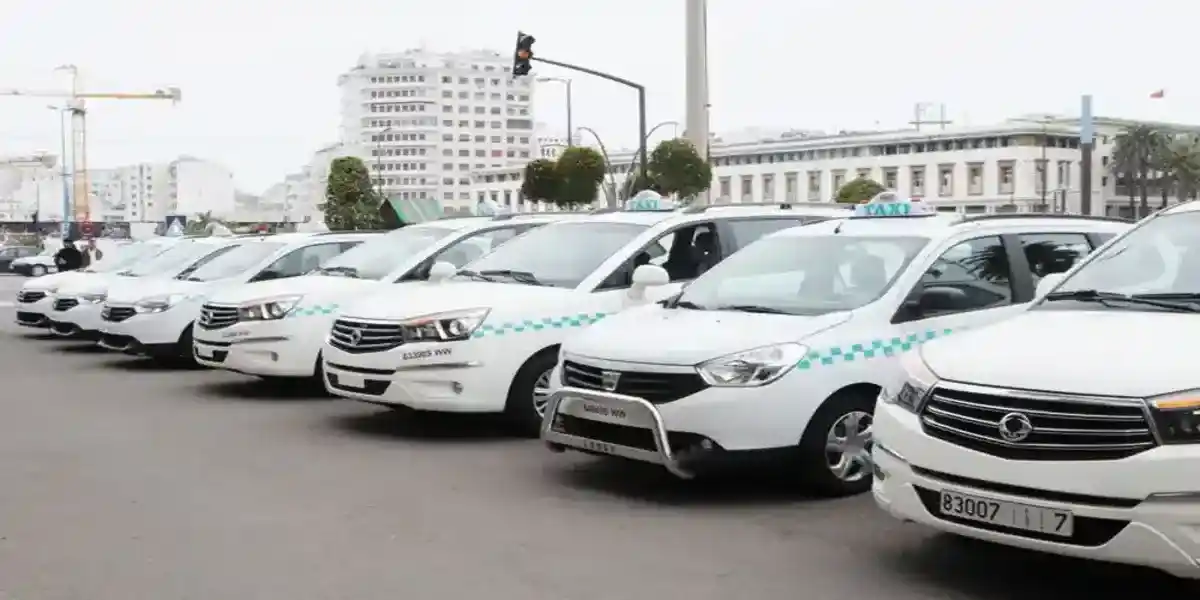
The first challenge is actually finding where Grand Taxis depart from. Unlike regular taxis that you can hail on the street, Grand Taxis operate from designated taxi stands called “gare routière” (literally “road station”).
Where to Look:
🚉 Bus and Train Stations The most reliable place to find Grand Taxis is at or near bus stations (gare routière) and train stations. In cities like Fez, Marrakech, and Casablanca, there are dedicated Grand Taxi areas right next to the main bus terminals.
⛴️ Ports and Ferry Terminals If you’re arriving by ferry from Spain (like in Tangier or Ceuta), you’ll find Grand Taxi stands right at the port exit. Super convenient!
🏨 Major Hotels Some larger hotels have arrangements with Grand Taxi drivers, though these tend to be more expensive. The hotel concierge can also direct you to the nearest taxi stand.
📍 City-Specific Locations Each city has its main Grand Taxi hub, usually on the outskirts. For example:
Marrakech: Bab Doukkala area for northbound travel
Fez: Gare Routière Aïn Kaïd
Tangier: Grand Taxi station near Place de la Ligue Arabe
💡 PRO TIP: Download the Maps.me app before your trip! It works offline and clearly marks Grand Taxi stations in most Moroccan cities. This saved me countless times when I couldn’t communicate the location to locals.
The Role of the Dispatcher (Chef de Station)
At most major Grand Taxi stands, you’ll encounter a dispatcher or station manager (chef de station). This person is crucial to understand!
What They Do:
Organize the queue of waiting taxis
Manage passenger flow to fill cars efficiently
Sometimes collect fares (especially on busier routes)
Ensure fair distribution of passengers among drivers
How to Work With Them:
Approach the dispatcher and state your destination
They’ll direct you to the appropriate line of taxis
You may pay them directly, or pay the driver once you’re underway
Don’t be shy about asking questions – most are helpful once you break the ice!
I remember my first time at the Marrakech Grand Taxi station feeling completely overwhelmed. But once I found the dispatcher and simply said “Essaouira?” with a questioning look, he smiled, pointed to a line of cars, and helped me understand the system. Sometimes all you need is to take that first step!
The Shared Ride System Explained
Alright, here’s where Grand Taxis get interesting (and potentially uncomfortable). Let me break down exactly how the shared ride system works.
The “Full Car” Rule
Grand Taxis operate on a simple principle: the taxi doesn’t leave until all 6 seats are filled.
The seating breakdown:
2 passengers in front (next to the driver)
4 passengers in the back (yes, four people squished across the back seat!)
Now, you might be thinking “That’s impossible!” but trust me, Moroccans have perfected the art of efficient seating. The middle seats are actually the most coveted because you have slightly more space. The outer seats mean you’re pressed against the door or another passenger for the entire journey.
The Waiting Game
This is where patience becomes your best friend. When you arrive at a taxi stand:
You’ll be directed to a taxi going to your destination
You get in and… wait
And wait some more
Eventually, other passengers arrive
Once the sixth passenger shows up, boom – you’re off!
How long does this take? It varies wildly. On popular routes (like Marrakech to Essaouira), you might wait just 10-15 minutes. On less common routes? I’ve waited up to an hour. This is why starting your journey early in the morning is often better – more people are traveling, so cars fill up faster.
The Relay System for Long Journeys
Here’s something that confused me initially: on longer routes, you often have to change taxis multiple times. This isn’t a scam – it’s just how the system works!
For example, traveling from Marrakech to Chefchaouen (about 600km) involves:
Grand Taxi from Marrakech to Fez
Change to a different Grand Taxi in Fez
Grand Taxi from Fez to Chefchaouen
Each leg is operated by different drivers who specialize in that particular route. They know the roads intimately, have established relationships with dispatchers on both ends, and this specialization actually makes the system more efficient.
Don’t worry – when you arrive at a change point, there will always be other Grand Taxis waiting. The drivers often help coordinate the handoff between vehicles. Just stay alert and keep your belongings close!
Buying Out the Taxi (Course Privée)
Can’t handle the wait or don’t want to be squished like sardines? You can pay for all 6 seats and have the taxi leave immediately with just you (and your travel companions).
When is this worth it?
-
- ✅ Time-Sensitive Travel If you have a flight to catch or a tight schedule, paying for a private taxi guarantees immediate departure.
- ✅ Comfort on Long Journeys For routes over 2-3 hours, having extra space to spread out can be worth the premium. I did this for the Marrakech to Ouarzazate journey and didn’t regret it for a second!
- ✅ Traveling with Lots of Luggage If you have hiking gear, surfboards, or large suitcases, buying extra seats gives you the space you need.
- ✅ Early Morning or Late Night If you’re traveling at odd hours when passenger volume is low, paying for all seats might be your only option to leave within a reasonable time.
- ✅ Traveling with Lots of Luggage If you have hiking gear, surfboards, or large suitcases, buying extra seats gives you the space you need.
- ✅ Comfort on Long Journeys For routes over 2-3 hours, having extra space to spread out can be worth the premium. I did this for the Marrakech to Ouarzazate journey and didn’t regret it for a second!
- ✅ Time-Sensitive Travel If you have a flight to catch or a tight schedule, paying for a private taxi guarantees immediate departure.
The Cost Calculation: Simply multiply the per-seat price by 6. For example:
Shared seat: 40 dirhams
Full taxi: 40 × 6 = 240 dirhams
Is it worth it? That’s your call! For me, on shorter routes (under 1 hour), I always go shared. On longer journeys or when I’m pressed for time, I happily pay the premium.
💰 Costs, Fares, and Negotiation Mastery
Understanding the Pricing Structure
Grand Taxi pricing can seem mysterious at first, but there’s actually a logic to it (most of the time!).
Fixed Fares for Standard Routes
Many popular routes have semi-official fixed prices that locals know and expect. These aren’t posted anywhere – they’re just common knowledge. For example:
Marrakech to Essaouira: 50-60 dirhams per seat
Fez to Meknes: 25-30 dirhams per seat
Tangier to Tetouan: 30-35 dirhams per seat
💡 HOW TO LEARN THE GOING RATE: Before getting in any taxi, ask a few different drivers what the price is. If multiple drivers quote similar amounts, that’s probably the standard fare. If one driver quotes significantly higher? Walk away and try another.
The Distance Formula
For routes without established prices, there’s a rough formula that works surprisingly well:
Price = Distance (km) × 2.22 dirhams
So a 100km journey would cost approximately 222 dirhams for all 6 seats, or about 37 dirhams per person.
Is this exact? No. But it gives you a baseline for what’s reasonable when negotiating.
Regional Price Variations
Prices are generally lower in less touristy areas and higher in major tourist cities. Marrakech and Essaouira have some of the highest Grand Taxi fares in Morocco, while prices in the Middle Atlas or the south tend to be much cheaper.
Negotiation Mastery: The Art of the Deal
Alright, this is where many travelers get frustrated, but I’m going to give you the exact strategy that works for me every single time.
🎯 GOLDEN RULE #1: ALWAYS Negotiate BEFORE Getting In
I cannot stress this enough! Never, ever get in a Grand Taxi without agreeing on the price first. Once you’re seated, you’ve lost all leverage. The driver can claim any price, and you’re stuck arguing in a confined space.
This happened to me once in Marrakech (lesson learned!). I hopped in thinking the meter would run, only to discover at the destination that the driver expected triple the normal fare. Don’t be me. Negotiate upfront.
The Negotiation Process (Step by Step)
Step 1: Greet Properly Start with “As-salamu alaykum” (peace be upon you). This simple gesture immediately frames you as respectful and culturally aware, not just a clueless tourist. You’d be surprised how much this helps!
Step 2: State Your Destination Clearly Point to it on your phone map if needed. Make sure you’re both talking about the same place.
Step 3: Ask “Šнal?” (How Much?) Let them quote first. This tells you immediately if they’re going for tourist pricing or local pricing.
Step 4: Know Your Number Based on research or asking other drivers, you should have a target price in mind. If their quote is close (within 10-20 dirhams), accept it. If it’s way high, make a counteroffer.
Step 5: The Counteroffer If they say 100 dirhams and you know it should be 60, don’t offer 60 immediately. Start at 50. This gives room for meeting in the middle.
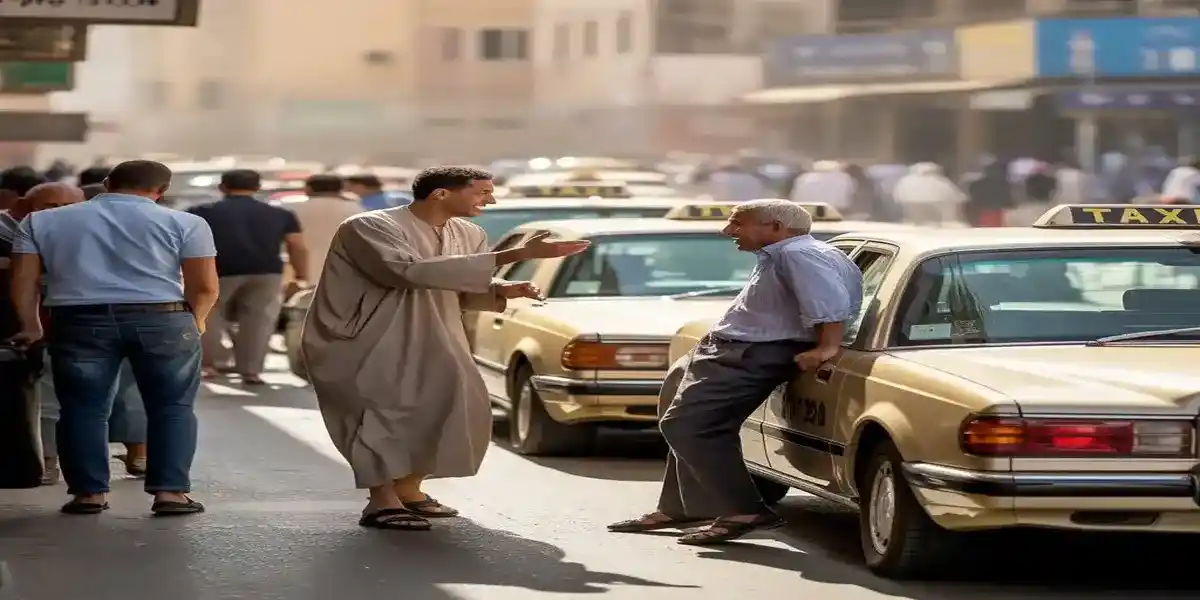
Step 6: Be Prepared to Walk Away This is your superpower. If they won’t budge from an unfair price, politely say “La shukran” (no thank you) and start walking to another taxi. I’d say 70% of the time, they’ll call you back with a better price.
Step 7: Seal the Deal Once you agree, repeat the price clearly: “Sittin dirham, wakha?” (60 dirhams, okay?). Get a clear confirmation, then get in.
🎭 Real Example from My Experience:
On a trip from Chefchaouen to Fez, the first driver quoted me 200 dirhams for a single seat. I knew this was ridiculous (it should be around 70-80).
Me: “La, ghali bezaf” (No, too expensive) Driver: “Tourist price! Very far!” Me: “I pay 70.” Driver: dramatic gesture “No possible! 180, final price!” Me: starts walking to next taxi Driver: “OK OK! 100 dirham!” Me: keeps walking Driver: “75! 75! Come back!” Me: accepts
The whole dance took 2 minutes. Could I have pushed lower? Maybe. But 75 felt fair, and I was happy with that price.
Local Price vs Tourist Price: Expectations
Let’s be real: you will often be quoted higher prices than locals. Is it fair? Debatable. Is it reality? Absolutely.
Moroccan vendors and drivers often operate on a sliding scale based on perceived ability to pay. A $5-10 premium on a fare isn’t going to bankrupt you, and for them, it might represent a meaningful portion of their daily income.
My philosophy: Negotiate to get close to the local price, but don’t fight over small amounts. If you’ve negotiated from 100 to 75, and locals might pay 70, the 5 dirham difference (about 50 cents) isn’t worth creating bad feelings.
That said, don’t be a pushover. If someone quotes you 300 dirhams for a journey that should cost 60, that’s not a “tourist premium” – that’s attempted robbery. Walk away confidently.
Payment and Practical Logistics
💵 Cash Only
Grand Taxis are a cash-only operation. I’ve never encountered a driver who accepts cards, and mobile payment apps aren’t standard. Always carry enough small bills (20, 50, and 100 dirham notes) to pay your exact fare.
Why exact change? Because the “I don’t have change” tactic is common. If you hand over a 200 dirham note for a 60 dirham fare, don’t be surprised if the driver suddenly can’t make change and suggests you just call it even.
The “Broken Meter” Excuse
Some Grand Taxis have meters (though this is increasingly rare). If you get in one that does, the driver might claim it’s broken and try to charge a negotiated rate instead.
Here’s the thing: Grand Taxis don’t typically use meters for inter-city travel anyway. Meters are standard in Petit Taxis, but Grand Taxis operate on fixed or negotiated fares. So if a driver mentions a meter, it’s likely outdated information or a setup for negotiation.
Just skip the meter discussion entirely and agree on a total price before departure.
Tip or No Tip?
Tipping isn’t expected in Grand Taxis, but rounding up is common courtesy. If your fare is 48 dirhams, giving 50 and saying “keep it” is a nice gesture. But don’t feel obligated to tip 10-20% like you might in restaurants.
🛡️ Practical Advice, Comfort, and Safety
Seating Arrangements and Capacity
Let’s talk about the elephant in the room: how exactly do 6 people fit in a sedan?
The Official Seating Configuration:
Front Seat:
1 driver
2 passengers squeezed next to the driver
Yes, this means the front passenger seat actually holds TWO people. If you’re traveling as a couple and one of you is smaller, the petite person usually goes in the shared front seat. The middle position has a bit of armrest, but it’s cozy (to put it mildly).
Back Seat:
4 passengers across
This is where things get intimate. The back seat breakdown:
Left window seat: Decent, but you’re leaning against the door for hours
Left middle: Actually not bad! You have the hump for foot space
Right middle: Similar to left middle
Right window seat: Same as left window
The middle seats are often considered “premium” because you’re not pressed against cold metal doors, and you can kind of wedge yourself into a comfortable position.
Where Does Luggage Go?
Ah, the million dirham question! Here’s the reality:
🎒 Small Bags and Backpacks These go on your lap or squeezed under your feet. If you have a backpack, it’s going on your lap for the journey. This is why traveling light in Morocco is such a blessing.
🧳 Medium Suitcases The trunk holds 2-3 medium suitcases maximum. If all 6 passengers have luggage, some bags will end up:
Strapped to the roof rack (common and generally secure)
In the passenger footwell
Taking up a precious seat (which you might have to pay for!)
🎿 Large or Awkward Items Surfboards, hiking gear, or oversized luggage often requires paying for an extra seat. The driver will typically negotiate this as “luggage seat” pricing.
💡 MY INSIDER TIP: When you arrive at the taxi stand with luggage, immediately show the dispatcher your bags and ask if there’s space. This prevents the awkward situation of getting assigned to a taxi that’s already luggage-full, only to wait another hour for a new car.
Safety and Vehicle Condition Reality Check
I’m going to be honest with you: Grand Taxis are not luxury vehicles. Most are 20-30 year old Mercedes that have seen better days. But here’s the thing – they’re generally safe, and Moroccan drivers know these routes like the back of their hand.
What to Expect:
🚗 Vehicle Condition
Worn interiors (ripped seats, faded upholstery)
Squeaky suspensions
Unclear origins of various smells
Possibly no working air conditioning (windows down all the way!)
Sometimes no working seatbelts in the back
Is this safe? Generally, yes. These cars are workhorses, and while they don’t win beauty contests, they’re mechanically maintained enough to handle daily use. I’ve taken dozens of Grand Taxi rides and never felt genuinely unsafe from a vehicle condition standpoint.
🛣️ Driving Style
Moroccan driving is… spirited. You’ll notice:
Frequent overtaking (even on mountain roads)
Creative interpretation of lane markers
Honking as communication
Speeds that might make you nervous
Should you be worried? Moroccan drivers are actually quite skilled. They navigate crazy traffic daily and know these roads intimately. That said, if you’re genuinely uncomfortable with the driving, you can politely ask them to slow down: “Šwiya bšwiya, 3afak” (slowly please).
On mountain routes (like going to Chefchaouen or through the Atlas Mountains), expect hairpin turns and cliffside driving. If you’re prone to motion sickness, sit in the front seat if possible and keep ginger candies handy!
🚨 Handling Issues
What if the driver takes an unexpected route? Sometimes drivers take alternate routes based on traffic, road conditions, or shortcuts they know. Usually this is fine. But if you feel genuinely concerned, use your phone GPS to track your route and ask questions if you’re going way off course.
What if there’s a breakdown? It happens occasionally. The driver will either fix it (they’re surprisingly skilled at roadside repairs) or call another taxi to transfer you. Don’t panic – this is part of the adventure!
What if you’re uncomfortable with another passenger? This is rare, but if someone is making you uncomfortable, speak up. Drivers generally maintain order in their vehicles. You can also request to switch seats or, in extreme cases, get out at the next town and catch a different taxi.
📱 Stay Connected
Always have:
A charged phone
GPS/maps app that works offline
Emergency contact numbers
Location sharing enabled with a friend or family member
These simple precautions mean you’re never truly alone, even on remote routes.
The Social Experience of Grand Taxis
One of my favorite aspects of Grand Taxi travel is the cultural immersion. You’re not insulated in a private car or tourist bus – you’re traveling exactly like Moroccans do.
What to Expect Socially:
🗣️ Conversations and Connections Moroccans are incredibly friendly and curious. If you speak even basic French or Arabic, you’ll likely have fascinating conversations with fellow passengers. I’ve gotten restaurant recommendations, learned about local festivals, and even been invited to family homes – all from Grand Taxi chats!
📵 Shared Silence Sometimes everyone just zones out, especially on early morning trips. Don’t feel obligated to entertain everyone – comfortable silence is perfectly acceptable.
👨👩👧👦 Cultural Observations You might notice:
Men and women generally avoid sitting directly next to each other (unless they’re family)
Older passengers get priority for the more comfortable seats
People are generally helpful with luggage and directions
Snacks and tea might be shared
Coping with Touts and Insistence
At busy taxi stands (especially in Marrakech), you’ll encounter “helpers” who want to guide you to a taxi… for a tip, of course.
My strategy:
Politely but firmly say “La shukran” (no thank you)
Walk purposefully like you know where you’re going (even if you don’t!)
Head directly to the dispatcher/station manager
Ignore persistent followers – they’ll eventually give up
Don’t feel bad about saying no. Setting firm boundaries actually earns more respect than being wishy-washy.
🚖 Alternatives to Grand Taxis
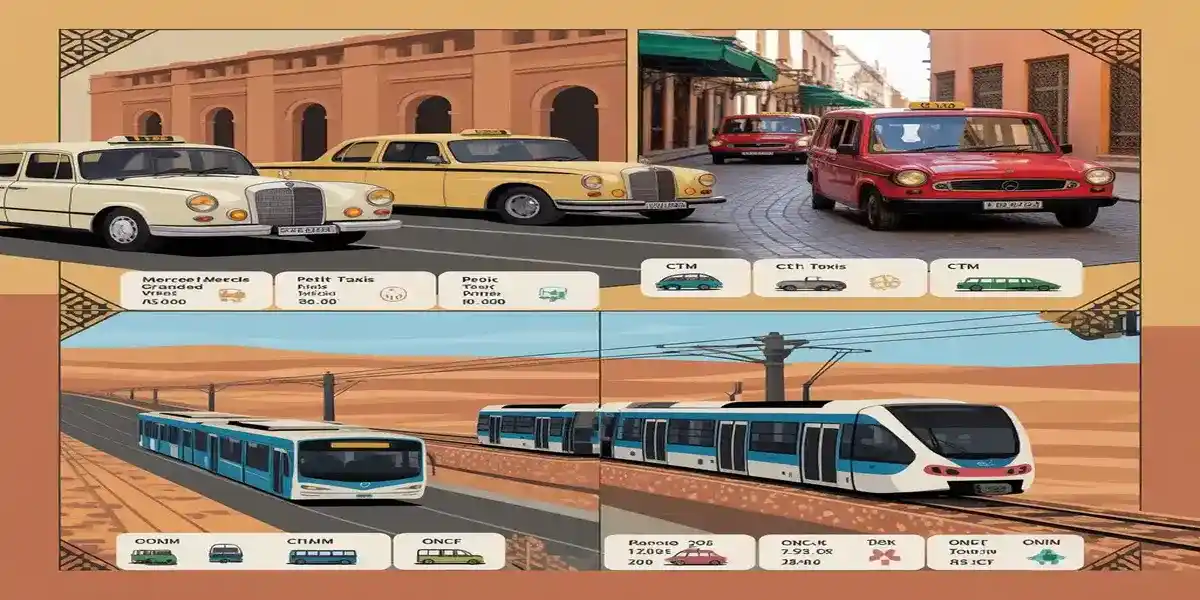
Grand Taxis are fantastic, but they’re not your only option. Let’s look at the alternatives so you can choose the best transport for each journey.
Petit Taxis: City-Only Transport
Petit Taxis are small urban taxis restricted to operating within city limits. They’re perfect for getting around town but useless for inter-city travel.
Key Characteristics:
Color-coded by city (red in Marrakech, blue in Fez, white in Tangier, etc.)
Maximum 3 passengers
Must use a meter (in theory!)
Can’t leave city boundaries
When to Use Petit Taxis: ✅ Short city trips (hotel to medina, restaurant to accommodation) ✅ When you’re in a hurry and don’t want to walk ✅ Late night travel within the city ✅ Rainy days (because Moroccan rain is no joke!)
Petit Taxi Pricing: Much cheaper than Grand Taxis! Expect:
Starting fare: 7-10 dirhams
Per kilometer: 1.50-2.00 dirhams
Most rides within a city: 20-40 dirhams
💡 PETIT TAXI PRO TIP: Always insist on the meter (“Compteur, ‘afak” – meter please). If they refuse, don’t get in. There are hundreds of taxis in every city – find one that will use the meter.
Modern Alternatives: VTC Apps (Careem, Roby, Heetch)
Morocco is entering the ride-sharing era! Several apps now operate in major cities, offering an alternative to traditional taxis.
📱 Careem (Uber’s Middle Eastern cousin)
Available in: Casablanca, Rabat, Tangier, Marrakech, Fez
Upfront pricing (no negotiation!)
Track your ride in real-time
Cashless payment option
Professional drivers with ratings
📱 Roby (Moroccan homegrown app)
Similar to Careem but locally developed
Competitive pricing
Growing fleet in major cities
📱 Heetch (European app expanding into Morocco)
Newer player but gaining traction
Often cheaper than Careem
Good for late-night rides
Pros of VTC Apps: ✅ No negotiation or haggling ✅ See your price before booking ✅ Driver accountability through ratings ✅ GPS-tracked routes ✅ Perfect for first-time visitors
Cons: ❌ Only available in large cities ❌ Sometimes 20-30% more expensive than local taxis ❌ Can surge price during peak times ❌ Require internet connection and local payment method
My Take: I use VTC apps for airport transfers and late-night city travel when I want zero stress. For daytime city travel, I still prefer regular Petit Taxis (they’re cheaper and I enjoy the interaction). For inter-city? Grand Taxis remain unbeatable.
📍 Map Reference Guide: Major Grand Taxi Routes
To help you plan your journey, here are the most common Grand Taxi routes with approximate shared-seat prices and journey times:
From Marrakech
🚗 Marrakech → Essaouira
Distance: 190 km
Time: 2.5-3 hours
Price: 50-60 dirhams per seat
Notes: Very popular route, cars fill quickly
🚗 Marrakech → Ouarzazate
Distance: 200 km
Time: 3.5-4 hours
Price: 70-80 dirhams per seat
Notes: Stunning Atlas Mountain scenery
🚗 Marrakech → Casablanca
Distance: 240 km
Time: 3-3.5 hours
Price: 70-90 dirhams per seat
Notes: Consider the train for this route (more comfortable)
🚗 Marrakech → Agadir
Distance: 250 km
Time: 3.5-4 hours
Price: 80-100 dirhams per seat
From Fez
🚗 Fez → Meknes
Distance: 60 km
Time: 1 hour
Price: 25-30 dirhams per seat
Notes: Very frequent service
🚗 Fez → Chefchaouen
Distance: 200 km
Time: 4-5 hours (mountain roads!)
Price: 70-80 dirhams per seat
Notes: Winding mountain route, amazing views
🚗 Fez → Ifrane
Distance: 65 km
Time: 1-1.5 hours
Price: 30-35 dirhams per seat
From Tangier
🚗 Tangier → Tetouan
Distance: 60 km
Time: 1 hour
Price: 30-35 dirhams per seat
🚗 Tangier → Chefchaouen
Distance: 115 km
Time: 2-2.5 hours
Price: 50-60 dirhams per seat
🚗 Tangier → Asilah
Distance: 45 km
Time: 45 minutes
Price: 25-30 dirhams per seat
From Casablanca
🚗 Casablanca → Rabat
Distance: 90 km
Time: 1.5 hours
Price: 35-40 dirhams per seat
Notes: Train is often better for this route
🚗 Casablanca → El Jadida
Distance: 100 km
Time: 1.5 hours
Price: 40-50 dirhams per seat
Less Common but Spectacular Routes
🚗 Dades Gorge → Todra Gorge
Distance: 110 km
Time: 2.5 hours
Price: 50-60 dirhams per seat
Notes: Incredible scenery, patience required for car to fill
🚗 Merzouga → Rissani
Distance: 40 km
Time: 45 minutes
Price: 20-25 dirhams per seat
Notes: Gateway to Sahara Desert
💡 ROUTE PLANNING TIP: These prices are for shared seats and current as of 2024-2025. Prices gradually increase over time and can spike during Ramadan and major holidays. Always confirm current pricing with multiple drivers before committing.
🎒 Packing Smart for Grand Taxi Travel
Your packing strategy can make or break your Grand Taxi experience. Here’s what I’ve learned after many journeys:
The Ideal Grand Taxi Bag
-
-
-
-
- ✅ Perfect: Medium daypack or small duffel
-
-
-
Soft sides (can squeeze into tight spaces)
30-40 liter capacity
Can sit on your lap without killing your legs
Easy to grab quickly
🎯 Special Situations and Pro Tips
Traveling Solo as a Woman
Many female travelers ask me about Grand Taxi safety. Here’s my honest take:
-
-
-
-
- ✅ Generally Safe I’m a solo female traveler, and I’ve taken dozens of Grand Taxis without serious issues. Moroccans are generally protective of solo women travelers.
-
-
-
🛡️ Smart Precautions:
Sit in the back seat if possible (middle position is actually safest)
Share your GPS location with someone
Dress modestly to avoid unwanted attention
If uncomfortable, request to sit next to another woman
Trust your instincts – if something feels off, wait for another taxi
💪 Assertiveness Helps: Don’t be afraid to advocate for yourself. Moroccan women are often quite assertive, and matching that energy earns respect.
Traveling with Kids
Grand Taxis with children require extra planning:
👶 Infants/Toddlers:
Lap-holding is standard (no car seats available)
Bring lots of snacks and entertainment
Consider buying extra seats for comfort
Travel during nap times if possible
🧒 Older Kids:
They count as full passengers (no child pricing)
Window seats help with motion sickness
Download movies/games on tablets beforehand
Traveling with Elderly or Disabled Passengers
♿ Accessibility Challenges: Grand Taxis are NOT accessibility-friendly. No ramps, high step-in, tight quarters.
Options:
Book a private taxi (pay for all seats) for easier boarding
Request front seat (easier access)
Ask driver for help with boarding/luggage
Consider VTC apps or private driver for better accessibility
Large Groups
Traveling with 3+ people? You have options:
Option 1: Fill Most of a Taxi If you’re 4-5 people, you’re almost filling the taxi anyway. Pay for the remaining 1-2 seats and have a semi-private ride.
Option 2: Book Two Taxis For groups of 7-12, booking two Grand Taxis often works well. Drivers sometimes coordinate to travel together.
Option 3: Private Minibus For 8+ people, a private minibus (minivan) might be more economical and comfortable. Ask at taxi stands about minibus options.
🚨 Common Scams and How to Avoid Them
Let’s talk about the unfortunate reality: tourist-focused scams exist. But they’re easy to avoid once you know the patterns.
The “Broken Meter” Scam
The Setup: Driver agrees to use meter, then halfway through journey claims it’s broken and quotes inflated price.
The Solution:
Agree on total price BEFORE getting in (makes meter irrelevant)
If they insist on meter, watch it start and confirm it’s running
Take a photo of the meter reading at start
The “No Change” Scam
The Setup: You pay with large bill, driver claims they have no change, suggests you “just pay more.”
The Solution:
Always carry exact change or close to it
Break large bills at ATMs, shops, or hotels
If they truly don’t have change, ask them to get change from nearby shop
Stand your ground – they’ll find change if you wait long enough
The “My Friend Will Take You” Scam
The Setup: Driver quotes reasonable price, but then passes you to “friend” who charges much more.
The Solution:
Clarify you’re negotiating with THIS specific driver
If they try to transfer you, renegotiate or refuse
This is more common with touts outside taxi stands
The “Scenic Route” Scam
The Setup: Driver takes unnecessarily long route to inflate time/distance-based fare.
The Solution:
Use GPS to follow your route
Know the approximate journey time
If wildly off course, question it immediately
The “Hotel Closed/Full” Scam
The Setup: Driver claims your hotel is closed/full and offers to take you to “better” place (where they get commission).
The Solution:
Call your hotel to confirm before leaving
Insist on going to your booked accommodation
Firmly say “No, take me to [hotel name]”
The Commission Tour
The Setup: Driver “helpfully” takes you to carpet shops, argon cooperatives, or “friends” shops during journey.
The Solution:
Make it clear at start: “Direct to [destination], no stops”
If they stop anyway, refuse to get out
Don’t feel obligated to buy anything
💡 REALITY CHECK: Most Grand Taxi drivers are honest, hardworking people just trying to make a living. Scams are the exception, not the rule. But being aware of common tactics protects you from the minority who prey on uninformed tourists.
🌟 Final Thoughts: Embracing the Grand Taxi Adventure
After all this detailed information, you might be thinking: “This sounds complicated!”
And you know what? It can be, especially your first few times. But here’s the beautiful truth: Grand Taxis are one of the most authentic, memorable, and rewarding ways to experience Morocco.
What I Love About Grand Taxis
🌍 Authentic Cultural Immersion You’re not insulated in a tour bus or rental car bubble. You’re traveling exactly how Moroccans travel, sharing space and conversation with locals going about their daily lives.
💰 Incredibly Economical When you split a Grand Taxi six ways, you’re paying a fraction of what a private transfer would cost. Budget travelers, this is your friend!
🚀 Flexible and Fast No waiting for scheduled departures. Once the car fills, you go. And you go DIRECT – no bus stops every 5km.
❤️ Unexpected Connections Some of my favorite Morocco memories are random conversations in Grand Taxis. Fellow passengers who recommended hidden restaurants, explained local customs, or simply shared their stories.
🏞️ Access to Everywhere Want to visit that remote Berber village or mountain kasab? Grand Taxis will take you there. They’re the transportation infrastructure of rural Morocco.
My Best Advice for First-Timers
1. Start with an easy route Your first Grand Taxi experience should be a popular, straightforward route (like Marrakech-Essaouira or Fez-Meknes). Save the complex multi-leg journeys for when you’re more comfortable with the system.
2. Learn those key Darija phrases Just “As-salamu alaykum,” “Šнal,” and “Shukran” will transform your experience. I promise.
3. Embrace the chaos Things won’t always go smoothly. You might wait longer than expected. The driver might drive faster than you’d like. Your seatmate might chat non-stop (or not at all). Roll with it! The unpredictability is part of the adventure.
4. Keep your sense of humor When you’re squished between two strangers with a chicken cage on your lap (yes, this happens!), you have two choices: get frustrated or laugh about it. Choose laughter. These become the best travel stories.
5. Stay safe but don’t be paranoid Take sensible precautions, but don’t let fear prevent you from this quintessentially Moroccan experience. Millions of tourists have taken Grand Taxis without incident.
The Bottom Line
Grand Taxis are safe, affordable, and absolutely worth experiencing. They’re not always comfortable, they require negotiation skills, and they definitely demand patience. But they offer something that sterile airport transfers and tour buses never can: genuine connection to the country and its people.
Your first Grand Taxi ride might be awkward. You might overpay. You might end up in the dreaded middle back seat for three hours. But you’ll also have an authentic Morocco experience that’ll make you feel like a real traveler, not just a tourist passing through.
So take a deep breath, practice your Darija greetings, and embrace the beautiful chaos that is Grand Taxi travel in Morocco. I promise it’ll be worth it.
Bslama and happy travels! 🚕🇲🇦