


Planning a Morocco 7-day road trip feels overwhelming at first. Which roads are safe? Where do you fill up before the desert? What vehicle do you actually need? I spent three weeks driving across Morocco last year, and I’m here to share everything I learned the hard way so you don’t have to.
Here’s the thing about a one-week Morocco itinerary — seven days is tight, but absolutely doable if you plan smart. You can hit the imperial cities, cross the High Atlas, sleep under the stars in the Sahara, and still have time to get lost in a medina or two.
This isn’t your typical “here are pretty places” guide. I’m giving you the real stuff: exact kilometers, actual driving times (not the Google fantasy version), where to fuel up before stations disappear, and which stretches will test your nerves. Because trust me, that mountain pass at dusk with no guardrails? You’ll want to know about it beforehand.
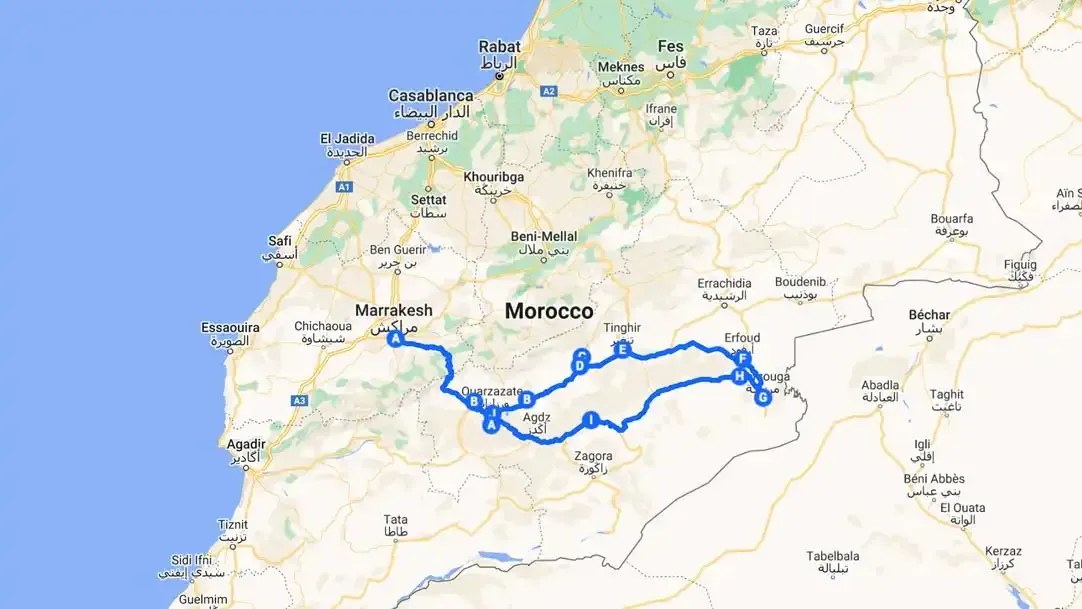
The classic Morocco road trip loop covering desert, mountains, and imperial cities
What This 7-Day Morocco Route Covers
This best 7-day Morocco route is designed as a loop starting and ending in Marrakech. Why Marrakech? Simple — it has the best flight connections, reliable car rental agencies, and positions you perfectly for both the Atlas Mountains and the desert.
Over seven days, you’ll experience three dramatically different landscapes. The High Atlas with its Berber villages and winding passes. The pre-Saharan valleys with their kasbahs and palm groves. And the actual Sahara dunes at Merzouga — the kind of orange sand sea you’ve seen in photos.
The total distance runs about 1,400 kilometers. Sounds like a lot? It’s manageable because you’re never driving more than 5-6 hours in a single day. Some days are shorter, giving you actual time to explore instead of just ticking boxes from behind a windshield.
Day-by-Day Itinerary: Your Morocco Road Trip 7 Days
Let me break down exactly what each day looks like. I’m including the real driving times, not the optimistic Google estimates that assume you won’t stop for photos, tea breaks, or that random roadside tagine that smells incredible.
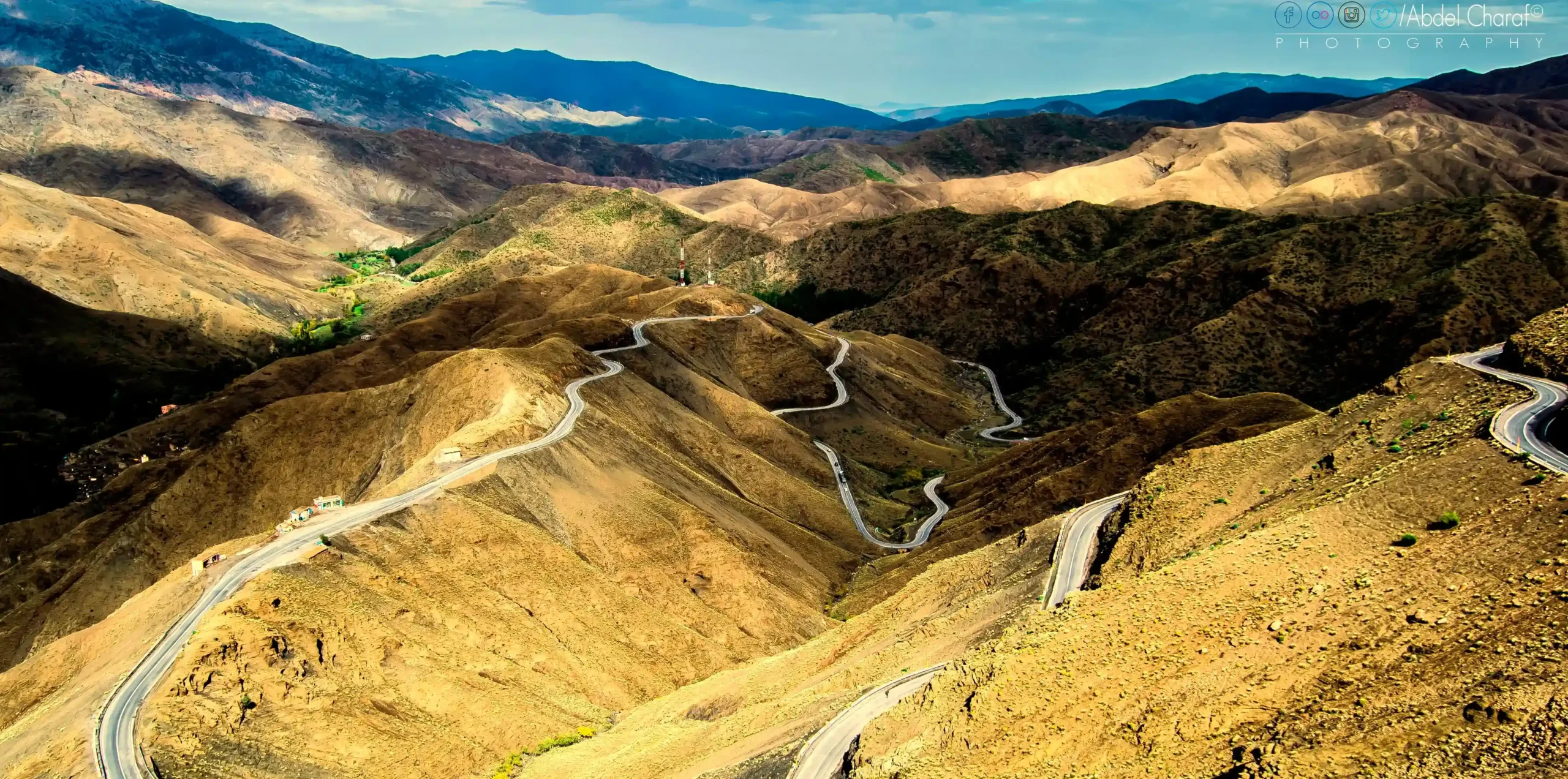
Day 1: Marrakech to Ouarzazate via Aït Benhaddou
Distance: 190 km
Google says: 4 hours
Reality: 5-6 hours with stops
Difficulty: Moderate to challenging (mountain pass)
Leave Marrakech early. Like, 7 AM early. The Tizi n’Tichka pass gets busy with tour buses by mid-morning, and you want clear roads for those 36 kilometers of switchbacks climbing to 2,260 meters.
Fill your tank in Marrakech before leaving. The next reliable station isn’t until Ouarzazate, and the mountain villages charge premium prices for questionable quality fuel.
Day 2: Ouarzazate to Todra Gorge
Distance: 180 km
Google says: 3 hours
Reality: 4-5 hours with exploration
Difficulty: Easy (flat desert roads)
Today’s drive follows the “Route of a Thousand Kasbahs” — and yes, there really are that many crumbling mud fortresses dotting the landscape. The N10 is smooth and fast, cutting through the Draa Valley with its date palm oases.
Stop in Kelaa M’Gouna if it’s rose season (April-May). The valley produces most of Morocco’s rose water, and the scenery is surreal — pink flowers against red desert earth.
Day 3: Todra Gorge to Merzouga (Sahara Desert)
Distance: 150 km
Google says: 2.5 hours
Reality: 3-4 hours
Difficulty: Easy (paved throughout)
The road to Merzouga used to be a rough piste. Now it’s fully paved, making the Sahara accessible to any vehicle. The landscape transforms gradually — from rocky desert to true sand dunes appearing on the horizon like orange mountains.
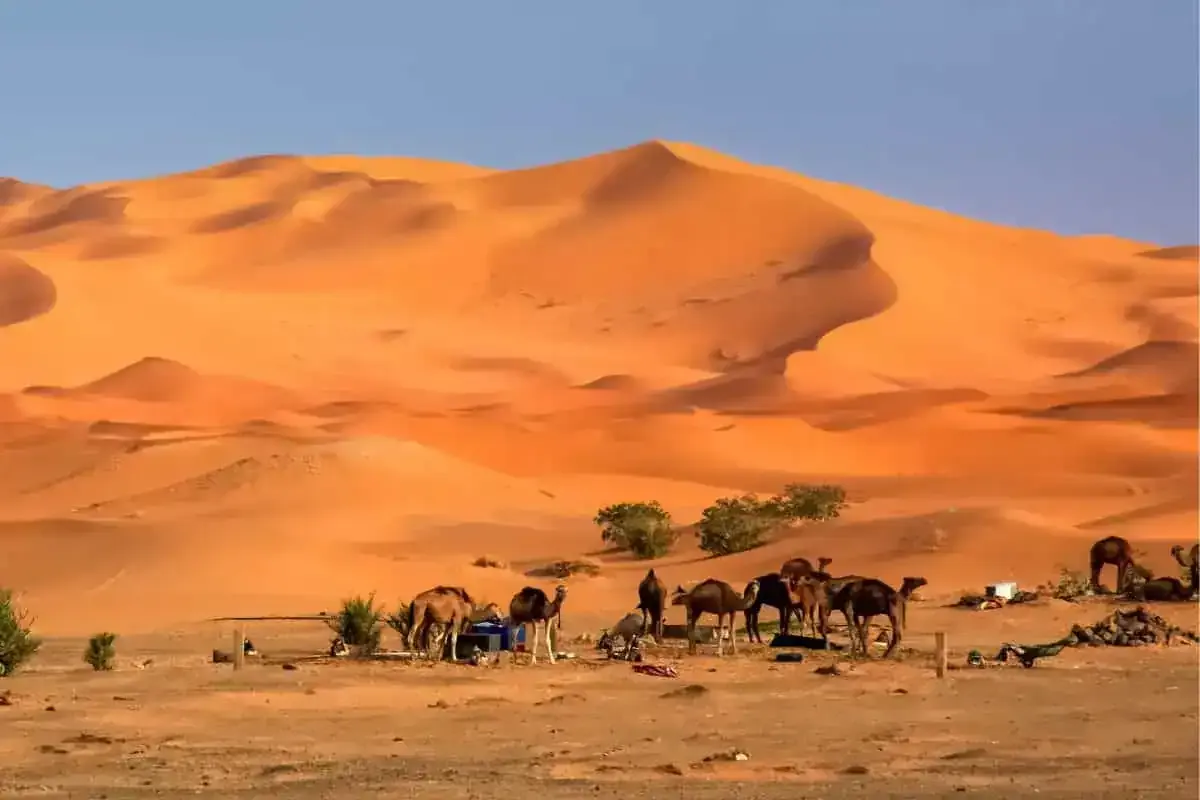
You’ll pass through Erfoud, the fossil capital of Morocco. Every shop sells ancient ammonites and trilobites. Some are genuine; many are fakes. Unless you’re a geologist, just enjoy the quirky roadside museums.
Day 4: Sahara Desert Day
Distance: 0 km (rest day)
Driving: None
Difficulty: Your legs might hurt from camel riding
This is why you came to Morocco. Leave the car. Forget the driving. Today is about the desert.
Wake before dawn for the sunrise over Erg Chebbi. Some camps arrange 4 AM departures so you’re positioned on a dune when the first light hits. It’s cold — desert temperatures drop to near-freezing in winter — but the colors make it worth every shiver.
Day 5: Merzouga to Midelt via Errachidia
Distance: 280 km
Google says: 4.5 hours
Reality: 5-6 hours
Difficulty: Easy to moderate
The longest driving day of your Morocco itinerary 7 days, but the roads are straightforward. You’re crossing the hammada — flat, rocky desert that looks like Mars — before climbing into the Middle Atlas.
Leave early again. The afternoon light gets harsh in the desert, and you want to reach Midelt before dark.
Day 6: Midelt to Fes
Distance: 200 km
Google says: 3.5 hours
Reality: 4-5 hours
Difficulty: Moderate (mountain roads)
Today you cross the Middle Atlas at Col du Zad (2,178 m) before descending into the imperial city of Fes. The scenery shifts from high plateau to cedar forests to fertile farmland.
The pass is well-paved but can have snow or fog in winter months (November-March). Check conditions locally before departing. Chains are rarely needed but ice patches happen.
Day 7: Fes to Marrakech
Distance: 530 km
Google says: 5 hours
Reality: 5-6 hours
Difficulty: Easy (highway driving)
The final stretch is the easiest driving of the week. Morocco’s A2 autoroute runs directly from Fes to Marrakech — smooth pavement, rest stops, fuel stations, no surprises.
Leave Fes by 9 AM to reach Marrakech with time to spare before rental car return (usually by 5-6 PM). The highway passes through unremarkable farmland, so don’t expect scenic stops.
Road Conditions and Safety Throughout Morocco
Moroccan roads range from excellent to “interesting.” Understanding what you’ll face helps you plan realistic driving times and choose the right vehicle.
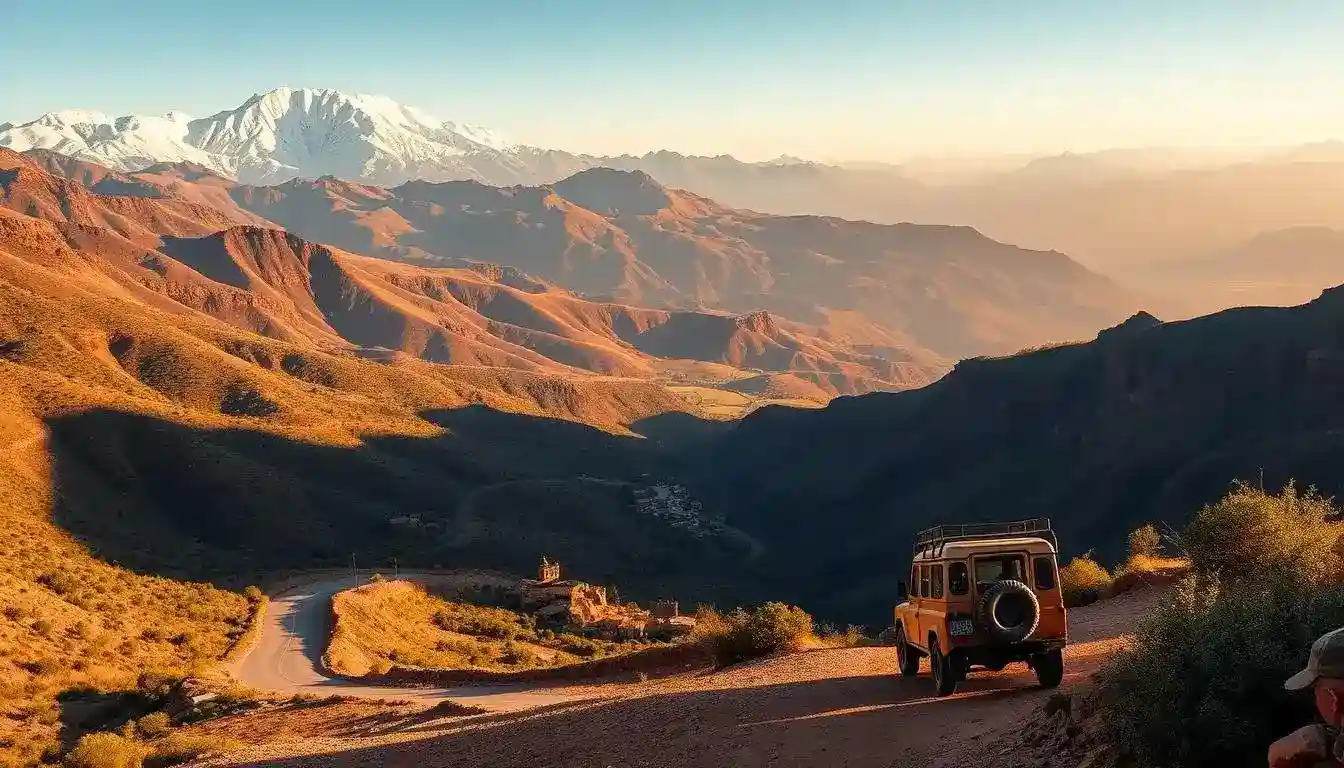
Typical mountain road conditions in the High Atlas — paved but demanding full attention
Highway Quality by Section
The autoroutes connecting major cities (Marrakech-Fes, Casablanca-Rabat) are European-standard. Well-maintained, clearly marked, with emergency phones every few kilometers.
National roads (N-routes) vary significantly. The N10 through the desert is excellent — recently repaved and wide. The N13 toward Merzouga is good but narrower. Mountain N-roads like the Tizi n’Tichka are technically sound but demand constant attention.
Fuel Stations and Where to Fill Up
Running out of fuel in the desert isn’t just inconvenient — it’s potentially dangerous. Here’s exactly where to tank up throughout your 1-week Morocco road trip.
Critical Last Stations Before Remote Areas
Before Tizi n’Tichka: Fill completely in Marrakech. Mountain villages have unreliable supply and higher prices.
Before Todra Gorge: Tinghir is your last proper station. The gorge itself has nothing.
Before Merzouga: Erfoud — don’t skip this. Merzouga’s supply is inconsistent and expensive.
Driving Safety: Police, Radars, and Local Hazards
Morocco’s roads present unique challenges. Here’s what to expect and how to handle common situations.
Speed Cameras and Radars
Morocco has deployed thousands of speed cameras. They’re everywhere — fixed installations, mobile units, even drones in some areas. Speed limits change frequently and without obvious signage.
General limits: 120 km/h autoroutes, 100 km/h national roads, 60 km/h towns, 40 km/h villages. When in doubt, slow down. Fines start at 400 dirhams and escalate quickly.
Budget Breakdown: What This Trip Actually Costs
Let’s talk numbers. Here’s what a best 7-day itinerary Morocco road trip actually costs in 2025, broken down by category.
Vehicle Rental
SUV compact (Dacia Duster or similar): 300-450 MAD/day = 2,100-3,150 MAD/week (€190-€290)
Full-size SUV (Toyota RAV4): 500-700 MAD/day = 3,500-4,900 MAD/week (€320-€450)
Book through reputable agencies. I recommend comparing prices at moroccotraveltrip.com before committing.
Your Essential Road Trip Checklist
Print this before you leave. Seriously.
Documents Required
- Valid passport (6+ months validity)
- International driving permit (technically required, rarely checked)
- Home country driver’s license
- Rental contract and insurance documents
- Credit card used for rental (for any claims)
- Emergency contact numbers on paper
In the Car
- Printed maps as backup (GPS fails in mountains)
- Offline maps downloaded (Maps.me or Google Maps)
- Phone charger and cable
- Power bank (fully charged)
- Water bottles (minimum 3 liters in desert sections)
- Snacks for long drives
- Sunglasses (essential, not optional)
- First aid kit (basic)
- Cash in small denominations (for parking, tips, tolls)
Vehicle Checks Before Departure
- Tire pressure (including spare)
- Spare tire condition
- Jack and wheel wrench present
- Hazard triangle in boot
- All lights working
- Fuel level (fill completely)
- Document any existing damage with photos
Apps to Download
- Maps.me (best offline navigation)
- Google Maps (download Morocco region)
- Google Translate (with Arabic and French downloaded)
- WhatsApp (how locals communicate)
- Currency converter
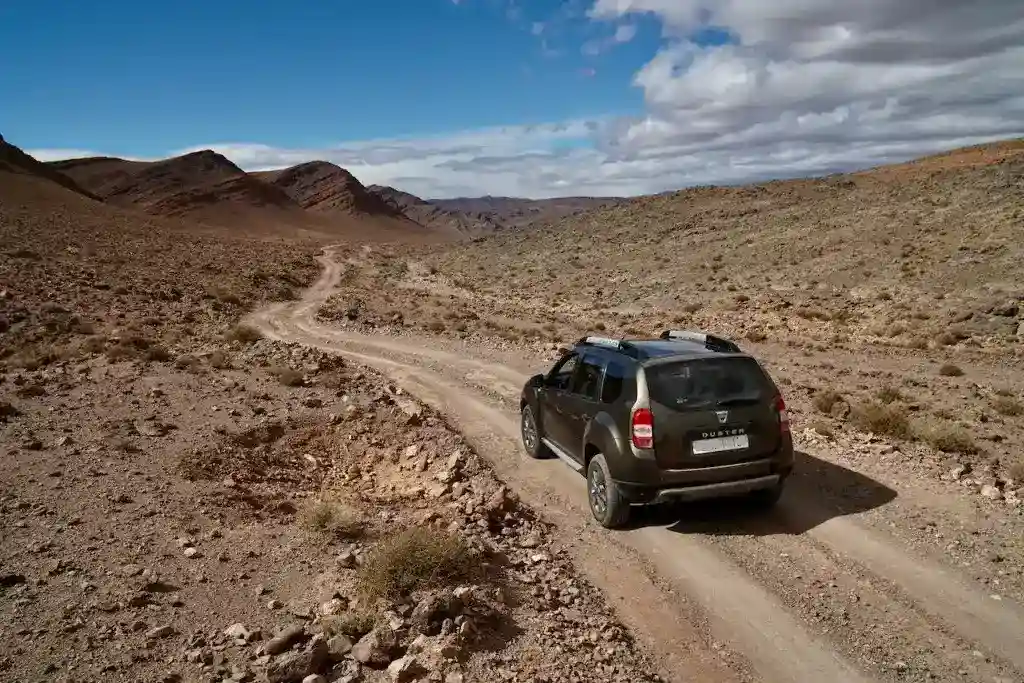
A compact SUV is all you need for this Morocco road trip route
Final Thoughts on Your One Week in Morocco
A Morocco 7-day road trip is one of those journeys that stays with you. The landscapes change so dramatically — sometimes within a single hour of driving — that you’ll fill more memory cards than you expected.
Seven days is enough. Not luxuriously long, but enough to taste Morocco’s diversity without exhausting yourself. You’ll wish for more time in certain places (everyone wants another day in the desert), but that just means you’ll come back.
The driving itself becomes part of the adventure. Yes, it’s occasionally nerve-wracking. Yes, you’ll question your sanity on that mountain pass. But you’ll also experience Morocco in a way that tour buses never allow — pulling over for unexpected views, stopping at roadside stalls, chatting with locals in villages that don’t appear in guidebooks.
Rent the car. Plan the route. Trust yourself. Morocco’s roads are waiting.
Have questions about planning your Morocco road trip 7 days? Drop them in the comments below. I check regularly and respond to every question I can.
More Road Trip Planning Resources
Before you go, check out these related guides: