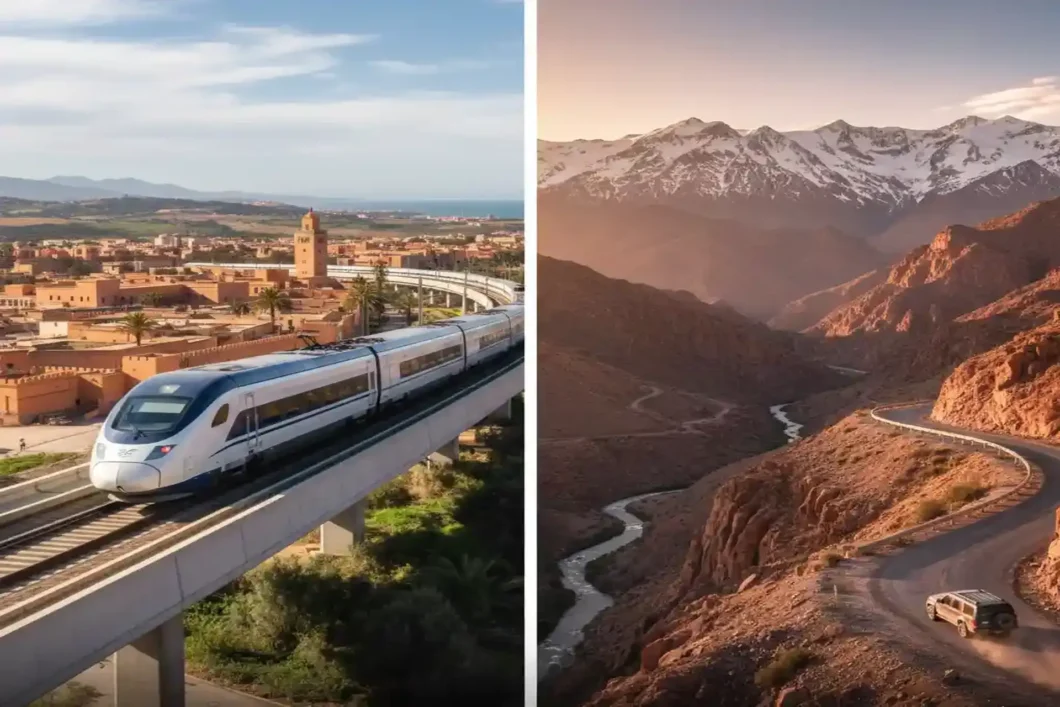
Choosing between car vs train Morocco for your 2026 journey requires understanding the geographic realities of Moroccan infrastructure. The country’s rail network, while modern and efficient within its coverage area, serves only the northern corridor and stops abruptly at Marrakech. Beyond this point, the entire south becomes a driver’s territory where renting a car in Morocco transforms from optional convenience to absolute necessity for independent travel.
This Morocco transport guide breaks down the technical logistics that determine your transportation strategy. The Al Boraq high-speed train connecting Tangier to Casablanca represents world-class rail infrastructure, yet the moment you plan a South Morocco road trip to Essaouira, the Drâa Valley, or the Sahara desert, you are dealing with entirely different Morocco travel logistics. The key is knowing exactly where one mode ends and the other begins, then optimizing your route accordingly.
Understanding driving in Morocco versus taking the train is not about choosing one over the other universally. It is about matching transportation mode to geographic sector. The Casa-Rabat train covers 87 kilometers in 45 minutes, faster than any car can manage through urban traffic. However, reaching Aït Benhaddou or Merzouga without a vehicle means depending on tour operators with fixed schedules and limited flexibility. This guide provides the data you need to construct an efficient, cost-effective transport plan for your Moroccan journey.
The Geographic Reality of Morocco’s Transport Network
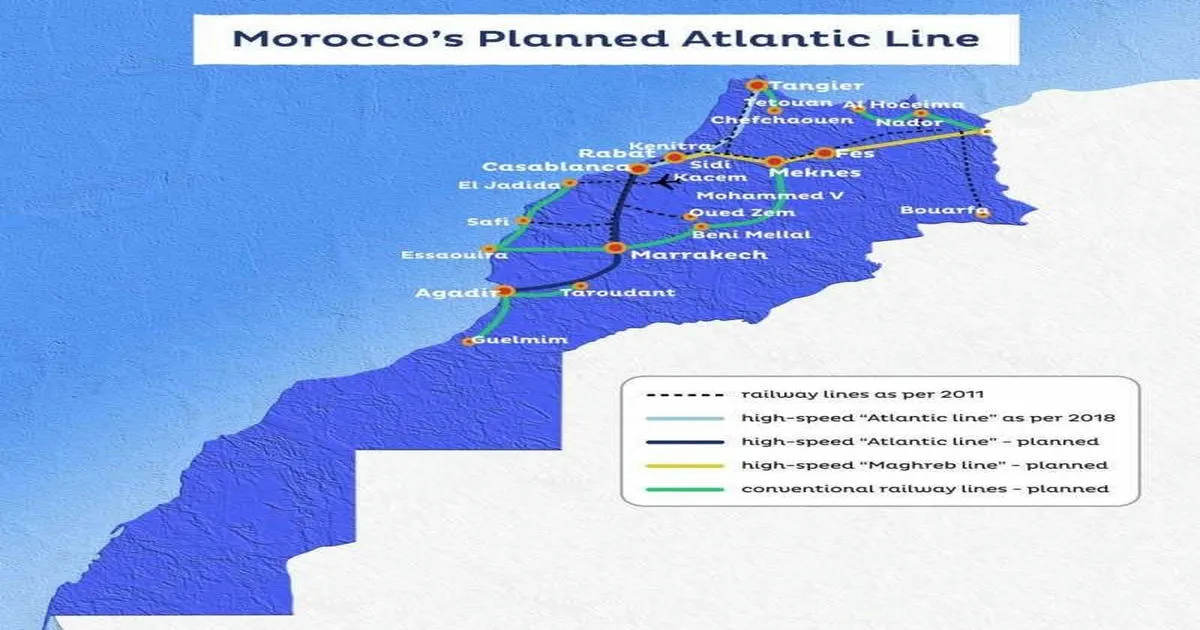
Morocco’s transport infrastructure divides cleanly into two zones: the northern rail corridor and the southern road network. The train system forms what logistics experts call the “Imperial Triangle” connecting Tangier, Fes, Casablanca, Rabat, and Marrakech through modern rail lines including the flagship Al Boraq high-speed service. This northern zone represents roughly 40% of Morocco’s territory but contains approximately 65% of its population and economic activity.
The rail network’s terminal point at Marrakech creates a hard boundary for Morocco train travel. South and east of this line, the entire Atlas Mountain region, the Atlantic coast beyond Essaouira, the Anti-Atlas, the Sahara desert, and the Drâa and Dades valleys are accessible only by road. This geographic division is not a planning inconvenience but rather a fundamental constraint that shapes all Morocco travel logistics for independent travelers.
Current Rail Infrastructure and Coverage
The Moroccan rail network operated by ONCF (Office National des Chemins de Fer) comprises approximately 2,110 kilometers of track as of 2026. The network’s core runs along the Atlantic coast from Tangier to Marrakech with an eastern branch serving Oujda via Fes and Meknes. The Al Boraq high-speed line, operational since 2018, covers the Tangier-Kenitra segment at speeds up to 320 km/h before connecting to conventional lines toward Casablanca.
Road Network Quality and Access
Morocco’s road infrastructure has seen substantial investment over the past two decades, creating a three-tier system that determines vehicle requirements and travel times. The autoroutes (toll highways) connect major cities with well-maintained asphalt comparable to European standards, charging tolls of approximately 0.80 MAD per kilometer. National roads (routes nationales) vary significantly in quality, from excellent two-lane highways to narrow mountain passes requiring careful navigation.
For those planning a South Morocco road trip, understanding road categories is critical. The N9 from Marrakech to Ouarzazate via the Tizi n’Tichka pass is a spectacular but demanding route with steep grades and hairpin turns where average speeds drop to 40-50 km/h. The coastal N1 from Agadir to Tan-Tan offers smooth, fast driving on well-maintained asphalt with minimal traffic. Regional roads (routes régionales) serving smaller towns and villages can be unpaved or poorly maintained, sometimes requiring 4×4 vehicles during winter months.
Detailed Road Quality Assessment
The Atlantic coastal corridor from Tangier to Agadir features excellent road infrastructure with the A1 autoroute serving most of the northern section. South of Essaouira, the N1 national road provides reliable two-lane access with good asphalt and clear signage. This route is suitable for standard economy cars and does not require specialized vehicles. Average travel speeds of 80-90 km/h are realistic on these coastal roads outside urban areas.
Strategic Transportation Planning by Destination
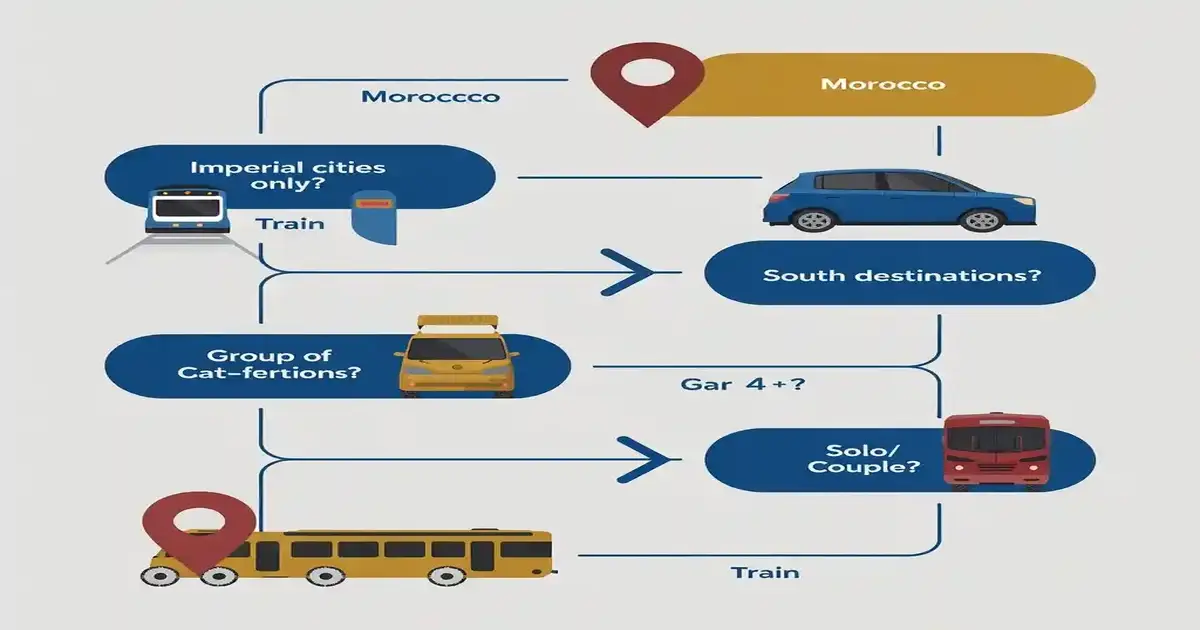
Effective Morocco travel logistics require matching transportation mode to specific destinations and route types. The decision between car vs train Morocco is not universal but rather depends on your precise itinerary segments. A 14-day Morocco journey typically benefits from a hybrid strategy: rail transport for the northern imperial cities corridor, then vehicle rental for southern exploration. This approach maximizes efficiency while minimizing costs and stress.
The fundamental principle is straightforward: if your destination has a train station and your schedule aligns with train departures, rail travel offers superior speed, comfort, and cost-effectiveness. If your destination lies outside the rail network or you need flexible departure times and the ability to stop at intermediate points, renting a car in Morocco becomes the logical choice. The following sections break down specific destination categories to guide your planning.
South Morocco and Atlas Mountains Access
Once your itinerary includes destinations south of Marrakech or east into the Atlas Mountains, renting a car in Morocco shifts from optional to essential. The entire zone encompassing Essaouira, Agadir, Ouarzazate, the Dades and Drâa valleys, and the Sahara desert areas of Merzouga and M’Hamid has zero rail connectivity. Public buses serve these routes but operate on limited schedules with long journey times that consume substantial portions of travel days.
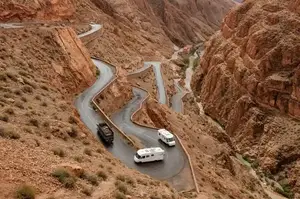
The South Morocco road trip presents some of Morocco’s most spectacular scenery but requires realistic planning around driving conditions. The Marrakech-Ouarzazate route via Tizi n’Tichka covers only 190 kilometers but requires 3.5-4 hours due to constant elevation changes and hairpin curves. Attempting this drive at night is inadvisable due to minimal lighting, potential rockfalls, and livestock on the roadway. The route from Ouarzazate to Merzouga spans 365 kilometers and requires approximately 6 hours, with the final sections crossing remote desert where fuel stations become sparse.
Essential Southern Driving Routes
The coastal route from Marrakech to Essaouira (175 km, 2.5 hours) offers one of Morocco’s most straightforward southern drives on well-maintained N8 highway. This route is suitable for any vehicle type and features minimal elevation changes. Essaouira itself is compact and walkable, making it ideal for a 2-3 day excursion with a rental car. Continuing south to Agadir adds another 175 km (2.5 hours) on similar quality roads, though Agadir’s urban sprawl makes it less pedestrian-friendly and somewhat less appealing for tourists seeking authentic Moroccan experiences.
Cost Analysis and Budget Optimization
Understanding the true costs of car vs train Morocco requires accounting for all variables beyond base ticket or rental prices. Train travel appears economical on paper with tickets ranging from 37 MAD for short segments like Casa-Rabat to 270 MAD for long-distance Al Boraq journeys. However, station-to-hotel transfers via petit taxi (typically 20-50 MAD) and the potential need for multiple tickets per day add up. Conversely, renting a car in Morocco involves the daily rental rate, fuel, tolls, parking fees, and insurance, creating a more complex calculation.
The economic break-even point typically occurs around 3-4 travelers. For solo travelers and couples on the Tangier-Rabat-Casablanca-Marrakech corridor, trains provide clear cost advantages. For families and groups, particularly those planning southern itineraries beyond the rail network, car rental becomes cost-effective when daily expenses are divided among passengers. The following detailed analysis provides the data needed to optimize your transportation budget for specific scenarios.
Train Travel Comprehensive Costs
Train ticket prices in Morocco use distance-based pricing with premium charges for Al Boraq high-speed services. Second-class tickets provide excellent value with comfortable seating, while first-class typically costs 30-40% more with only marginal improvements in space and quietness. For budget optimization, second-class suffices for journeys under 3 hours. For the 7+ hour Fes-Marrakech route via Casablanca, first-class provides worthwhile additional comfort for the small price difference.
Hybrid Strategy for Optimal Value
The most cost-effective approach for many travelers combines both transportation modes strategically. This hybrid strategy uses Morocco train travel for the efficient northern corridor while renting a car in Morocco only for the southern segment where rail does not exist. This approach minimizes car rental days while maximizing access to all desired destinations.
A sample 14-day itinerary using hybrid transport might structure as follows:
Days 1-5: Train-based northern loop
Tangier (2 nights) → Fes (2 nights) → Marrakech (1 night)
Transport: 3 train journeys = ~550 MAD per person
Benefits: Fast city-center connections, no driving stress in complex medinas, optimal for first-time visitors building familiarity with Morocco
Days 6-12: Car rental for southern exploration
Pick up car in Marrakech → Essaouira (2 nights) → Ouarzazate via Aït Benhaddou (1 night) → Dades Valley (1 night) → Merzouga (2 nights) → return to Marrakech (1 night) → drop car
Transport: 7-day car rental covering ~1,400 km
Benefits: Complete access to southern highlights, flexible scheduling, ability to stop for photos and exploration
Days 13-14: Train return to Casablanca/Rabat for departure
Marrakech → Casablanca → Airport or final city
Transport: 1-2 train journeys = ~140 MAD per person
Benefits: Avoid driving stress before international flight, utilize efficient Casa-Rabat corridor
This hybrid approach for a couple costs approximately 690 MAD per person for train segments plus 3,450 MAD per person for the 7-day car rental segment, totaling 4,140 MAD per person (~€375). While more expensive than pure train travel on the northern corridor, it provides access to Morocco’s most photographed and memorable landscapes in the south that train-only travel cannot reach. For travelers whose primary interest centers on imperial cities, staying train-only and taking organized day trips from Marrakech to Atlas destinations offers a lower-cost alternative.
Practical Booking and Logistics
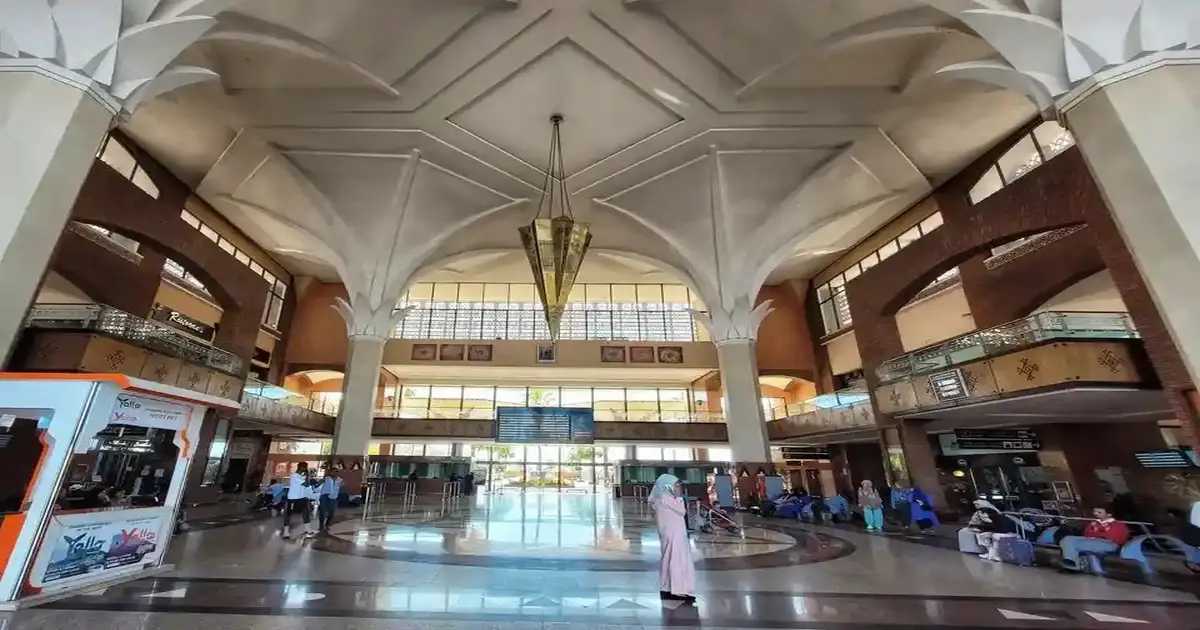
Executing your Morocco transport guide strategy requires understanding booking procedures, document requirements, and operational logistics for both train travel and car rental. The Moroccan rail system and rental car industry operate with different standards than travelers may expect from European or North American counterparts, making advance preparation essential for smooth execution. The following sections detail the practical steps required to secure your chosen transportation mode with optimal pricing and minimal complications.
Operational Logistics and Safety Considerations
Understanding operational realities of driving in Morocco prevents surprises that could disrupt your itinerary. Moroccan traffic patterns, road signage systems, fuel availability, and police procedures differ from European and North American norms. Advance knowledge of these factors allows you to navigate efficiently and legally while avoiding common mistakes that frustrate foreign drivers.